


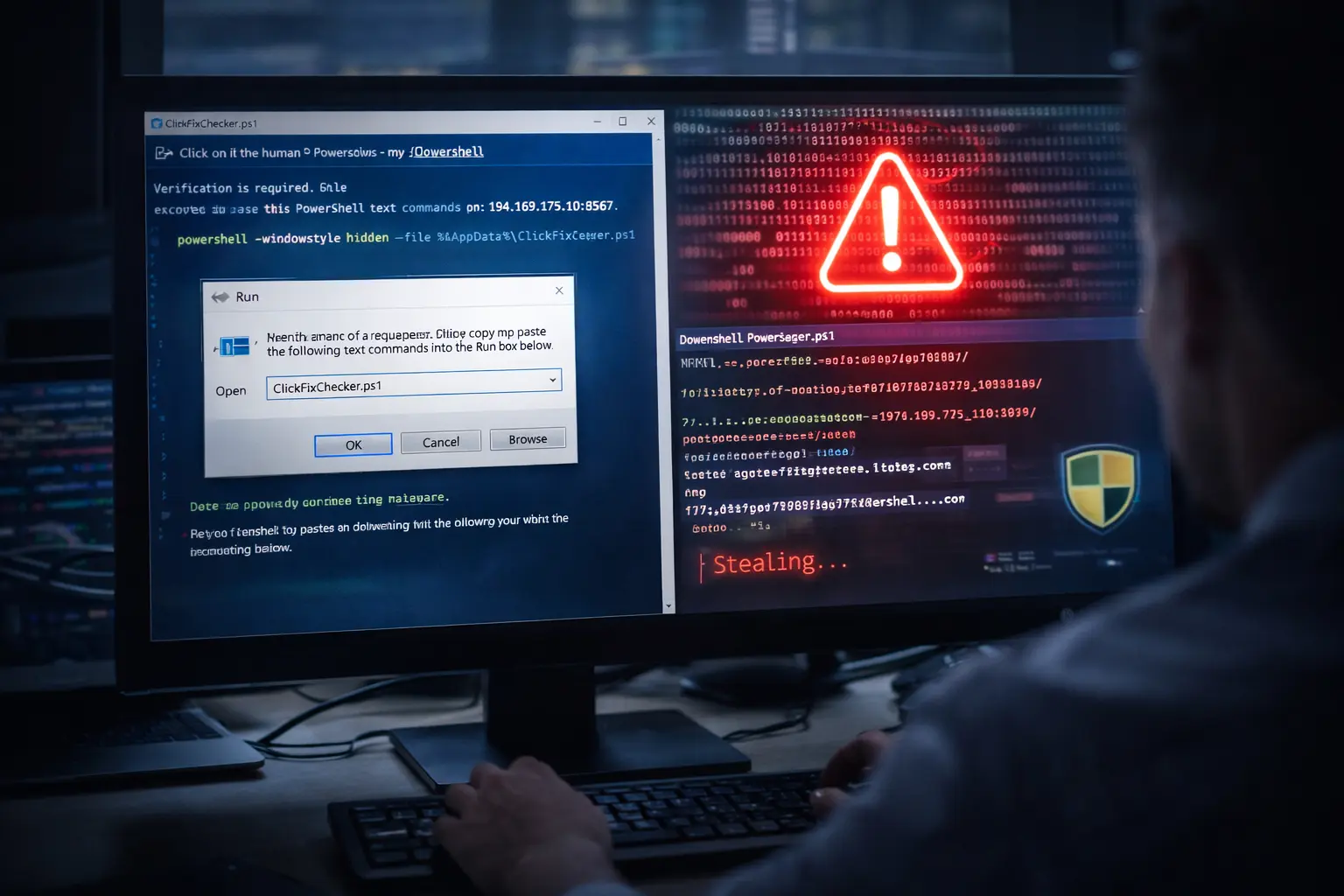
ClickFix App-V malware attacks show how threat actors continue to refine social engineering tactics. Attackers now abuse trusted Windows components to push malware onto victim systems. They rely on fake human-verification prompts and Microsoft’s Application Virtualization framework to bypass security controls. This method succeeds because it persuades users to trigger the attack themselves.
The campaign highlights a broader shift in cybercrime. Attackers increasingly favor deception and built-in system tools instead of exploiting software flaws.
How the ClickFix Technique Works
The attack starts when a malicious webpage displays a fake CAPTCHA or verification prompt. The page instructs users to copy and paste commands into the Windows Run dialog. Victims believe they are completing a routine verification step, which lowers suspicion.
After execution, the command launches a Windows App-V script. That script immediately starts PowerShell in the background and initiates the malware deployment process.
Why Attackers Abuse App-V Scripts
Windows App-V scripts carry digital signatures and operate as trusted components. Security tools typically allow them to run without interruption. Attackers exploit this trust by using App-V as a delivery mechanism for malicious commands.
This approach lets malware blend into normal system behavior. As a result, traditional signature-based defenses struggle to detect the attack during its early stages.
Malware Delivered Through the Attack Chain
After execution, the attack installs information-stealing malware. These payloads actively collect browser data, saved credentials, session tokens, and other sensitive information. Some variants also establish persistence and download additional malware components.
Once attackers steal this data, they often use it for account takeovers, financial fraud, or deeper network access. A single compromised endpoint can expose larger environments.
Why Users Fall for ClickFix Attacks
ClickFix App-V malware attacks succeed because they exploit user trust. Many users regularly solve CAPTCHA challenges and follow on-screen instructions. Attackers mimic these familiar workflows to reduce hesitation.
The use of built-in Windows tools further lowers suspicion. Users rarely question system features, even when those features behave in unusual ways.
How Organizations Can Reduce Exposure
Organizations should limit unnecessary script execution and closely monitor PowerShell activity. Behavior-based endpoint protection tools provide stronger detection than signature-only solutions. Teams should also disable or restrict App-V where it serves no operational purpose.
Security training remains essential. Employees must understand that legitimate websites never ask users to execute commands manually.
Conclusion
ClickFix App-V malware attacks demonstrate how cybercriminals weaponize trust in Windows components. By convincing users to execute malicious commands through legitimate scripts, attackers gain a stealthy and effective delivery method. Organizations can reduce risk by combining technical controls with continuous user awareness and monitoring.
0 responses to “ClickFix App-V Malware Attacks Abuse Windows Scripts to Push Malware”