


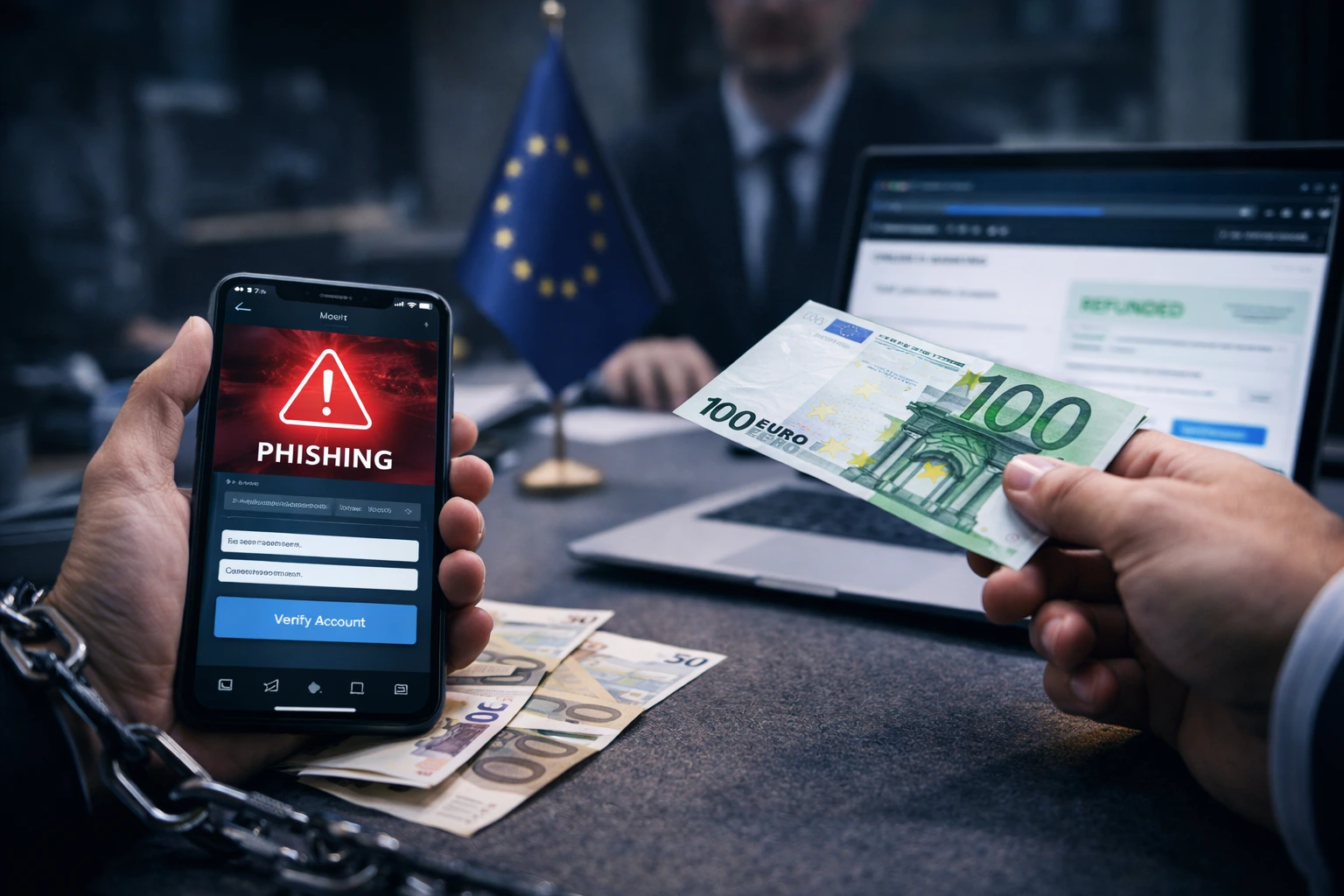
Phishing victim refunds could soon become a legal requirement across the European Union. A senior legal adviser to the Court of Justice of the European Union has stated that banks must reimburse customers immediately after unauthorized transactions caused by phishing attacks.
The opinion strengthens consumer protections under EU payment rules. It argues that victims should regain access to their stolen funds quickly instead of waiting for lengthy investigations. If the court follows this recommendation, banks across the EU may need to change how they handle fraud reimbursement.
A Phishing Scam Triggered the Case
The legal dispute began after a Polish bank customer became the target of a phishing scam. The victim listed an item for sale online and later received a message from someone posing as a buyer.
The attacker sent a fraudulent link designed to look like the bank’s login page. The victim entered their banking credentials on the fake site. This allowed the attacker to gain access to the account and initiate an unauthorized transfer.
The victim reported the incident to the bank and authorities the following day. However, the bank refused to reimburse the stolen funds and argued that the customer acted negligently by entering their credentials on a fake website.
The dispute eventually reached the Polish courts, which asked the EU’s highest court to clarify how European payment laws apply to phishing incidents.
EU Payment Rules Prioritize Consumer Protection
According to the court adviser, EU payment legislation requires banks to refund unauthorized transactions immediately after they are reported.
The interpretation focuses on the Payment Services Directive, which aims to protect customers using digital banking services. Under this framework, financial institutions must return the stolen amount without delay when a payment occurs without the user’s authorization.
The adviser emphasized that reimbursement should occur even if the bank believes the customer may have contributed to the incident. The refund must happen first, ensuring that victims do not suffer prolonged financial harm.
Banks May Still Investigate After Refunds
Although the opinion supports immediate refunds, banks may still investigate the circumstances of the fraud.
If a bank later proves that a customer acted intentionally or with gross negligence, it may attempt to recover the refunded funds through legal channels. This approach balances consumer protection with the ability for banks to challenge suspicious cases.
The adviser’s reasoning ensures that victims regain control of their finances quickly while leaving room for further investigation.
Potential Impact Across the European Union
If the Court of Justice adopts this legal interpretation, the decision could significantly change banking practices across the EU.
Many financial institutions currently reject reimbursement requests when customers share login credentials with phishing sites. A ruling in favor of the adviser’s interpretation would reverse that process by requiring banks to issue refunds first.
This shift would strengthen financial protection for consumers at a time when phishing scams continue to grow in sophistication.
Banks may also need to improve fraud detection systems and customer education efforts to reduce phishing-related losses.
Conclusion
The debate around phishing victim refunds highlights the growing tension between consumer protection and financial fraud prevention. The EU court adviser argues that victims should receive their money back immediately after unauthorized transactions occur.
If the Court of Justice follows this recommendation, banks across the European Union will likely need to revise their fraud response policies. Immediate reimbursement could become a standard requirement, ensuring that phishing victims do not bear the financial consequences of cybercrime.
0 responses to “Phishing Victim Refunds Could Become Mandatory Under EU Law”