


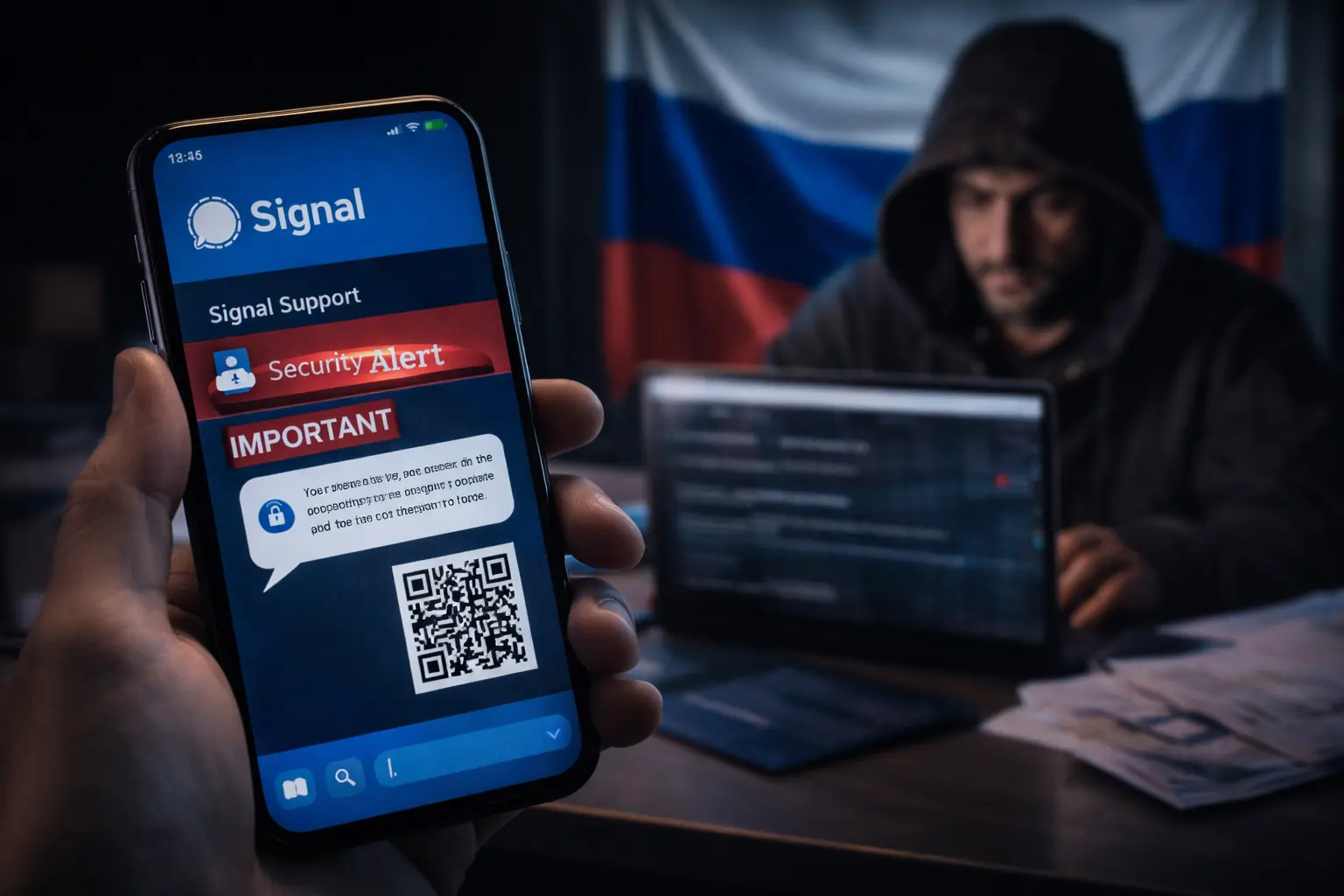
A new wave of targeted attacks is shifting focus away from breaking encryption and toward exploiting users. The Signal phishing campaign, linked to Russian intelligence, shows how secure messaging platforms can still be compromised through account takeover. Instead of attacking the technology, threat actors are targeting how people use it.
Targeted Campaign Focuses on Account Access
The campaign centers on gaining access to user accounts rather than exploiting technical flaws. Attackers approach victims directly, often posing as trusted contacts or legitimate services.
These messages are designed to appear credible and time-sensitive. This increases the likelihood that targets will engage without verifying the request. Once contact is established, attackers guide victims through steps that grant access to their accounts.
The approach allows threat actors to bypass traditional security controls without triggering alarms tied to system vulnerabilities.
Verification Abuse Enables Takeover
The key method involves abusing verification processes. Victims are tricked into sharing login codes or scanning malicious QR codes.
These actions allow attackers to link their own devices to the victim’s account. In some cases, they can take full control of the account without the user realizing it immediately.
This technique avoids direct interaction with encryption itself. Instead, it uses legitimate features in unintended ways to gain access.
Social Engineering Drives Success
The campaign relies heavily on social engineering. Messages are carefully crafted to match the tone and context of real communication.
Attackers use urgency, authority, or familiarity to push victims into quick decisions. This reduces the chance that targets will question the request.
The effectiveness of this method highlights a consistent pattern. Human behavior remains easier to exploit than hardened systems.
High-Value Individuals in Focus
The operation targets individuals with access to sensitive information. This includes government officials, journalists, and others involved in political or strategic environments.
By compromising these accounts, attackers gain insight into private conversations and networks. They can also use the compromised accounts to expand the attack further.
This turns each successful breach into a potential entry point for broader intelligence gathering.
A Shift in Attack Strategy
The Signal phishing campaign reflects a wider shift in cyber operations. Attackers are moving away from complex technical exploits and toward scalable, human-focused methods.
This strategy lowers the cost of attacks while maintaining high impact. It also makes detection more difficult, as the activity often appears as normal user behavior.
As these techniques evolve, similar campaigns are likely to expand across other platforms.
Conclusion
Signal phishing linked to Russian intelligence shows how modern threats are adapting to strong encryption. Instead of breaking secure systems, attackers are working around them by targeting users directly.
This shift changes how security should be approached. Protecting accounts now depends as much on user awareness as it does on technical safeguards.
0 responses to “Signal phishing linked to Russian intelligence”