


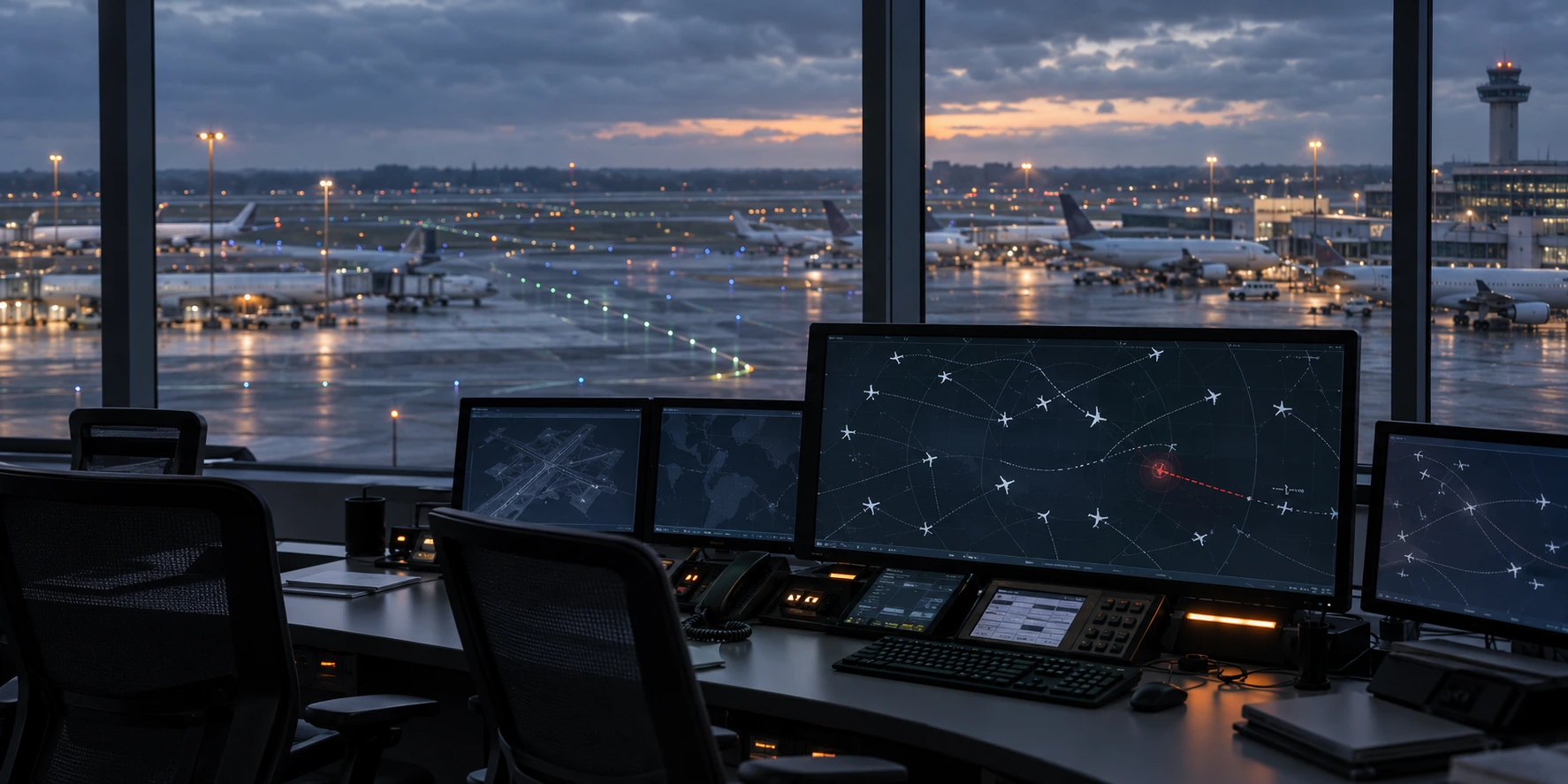
A software error lasting just a millisecond caused more than 2,000 UK flight cancellations on September 8. The disruption affected around 330,000 passengers and took over two days to clear.
NATS Identifies Software Defect
National Air Traffic Services published its preliminary investigation into the incident on September 18.
The UK air traffic control provider traced the failure to a small section of code in one of its flight data systems.
NATS chief executive Martin Rolfe said the company had identified the defect. It has introduced temporary safeguards while teams test and prepare a permanent fix.
The affected software assigns identification codes to aircraft. Air traffic controllers use these codes to recognise individual flights on radar.
Error Occurs Within a Millisecond
The failure began while the system processed a request to assign an aircraft code manually.
During that process, the software received a message for a higher-priority task. Therefore, it temporarily paused the original request.
However, a previously unknown defect prevented the system from resuming the task correctly. The failure then corrupted the resulting output and affected subsequent flight data updates.
According to the preliminary report, this entire sequence happened within a millisecond.
System Initially Appears to Recover
The software error first occurred at 10:00 a.m. Two minutes later, controllers and engineers received an alert about a failed connection between two flight systems.
However, the warning disappeared after 45 seconds. This suggested that the connection had restored itself successfully.
At 12:30 p.m., staff received new warnings about repeated connection failures. Controllers then started handling some tasks manually.
At the time, teams did not know that the connection had begun disconnecting automatically as a safety measure. Repeated attempts to process corrupted flight data had continued to time out.
NATS declared a major incident at approximately the same time.
Air Traffic Restrictions Spread Across UK
NATS introduced flight restrictions to reduce the workload on the affected systems.
Initially, the problem centred on the London Area Control Centre. However, controllers had to extend the restrictions across the UK.
Engineers needed to restart the affected system and reload flight data. Meanwhile, the traffic limits helped controllers maintain safe operations during the recovery.
The restrictions remained active for around six hours. Nevertheless, the consequences continued long after NATS restored the system.
Airlines needed more than two days to clear disrupted schedules and reposition aircraft and crews.
More Than 2,000 Flights Cancelled
The software failure affected roughly 30% of the flights scheduled for September 8.
Industry body Airlines UK estimates that approximately 330,000 passengers faced cancellations or delays.
More than 155,000 people had flights cancelled. Meanwhile, delays affected over 180,000 passengers.
The disruption created long queues and widespread uncertainty at UK airports. It also affected passengers travelling to and from international destinations.
NATS Rules Out Cyberattack
NATS found no evidence that a cyberattack or malicious activity caused the disruption.
The provider also said the incident had no connection to the major UK air traffic outage in 2023. Although both events caused widespread delays, different technical problems triggered them.
Rolfe apologised to affected passengers and acknowledged the scale of the disruption. However, he stressed that flight safety never came under threat.
NATS prioritised reducing air traffic while engineers investigated the failure. As a result, the system continued to protect aircraft despite the severe operational impact.
Airlines Demand Compensation
Airlines have demanded tens of millions of pounds in compensation for the disruption.
Airlines UK represents carriers including British Airways and Virgin Atlantic. The organisation called for immediate compensation and a credible plan to improve the resilience of NATS systems.
EasyJet chief executive Kenton Jarvis also called for a fair solution. He argued that airlines should not have to cover the full cost of the air traffic control failure.
Meanwhile, Ryanair demanded Rolfe’s dismissal. The airline rejected the software explanation and criticised NATS for the widespread disruption.
NATS Promises Further Investment
Rolfe said NATS has invested more than £1 billion in systems and technology over the past decade.
The organisation also plans to submit proposals to the Civil Aviation Authority for further investment. These plans could provide another £1 billion for technology and infrastructure by the end of 2033.
However, airlines want stronger assurances that similar failures will not cause another wave of UK flight cancellations.
The investigation will now focus on the underlying code and the system’s recovery mechanisms. NATS must also determine why the initial connection warning disappeared despite the continuing data-processing problem.
0 responses to “Software Glitch Causes 2,000 UK Flight Cancellations”