


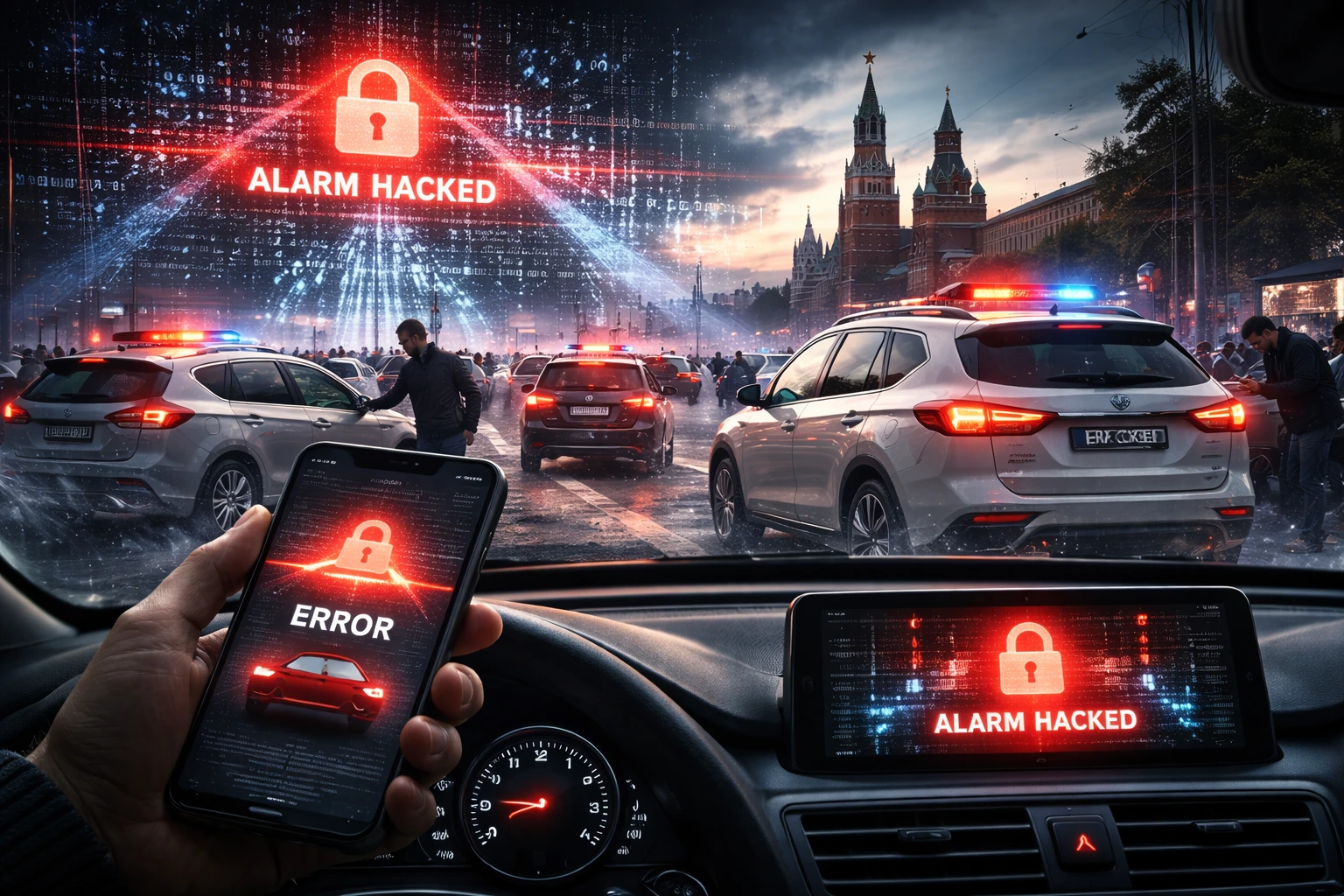
Russian car alarm cyberattacks caused widespread disruption after a major connected vehicle security service suffered a large-scale outage. Thousands of drivers suddenly lost access to essential vehicle functions, including remote unlocking, engine start, and alarm control. The incident highlighted how deeply modern vehicles rely on cloud-based security systems.
What began as a technical failure quickly became a real-world mobility issue. Drivers across multiple regions found themselves unable to use their vehicles normally. The disruption exposed weaknesses in connected automotive infrastructure that extend beyond convenience features.
What triggered the disruption
The outage followed a cyberattack targeting backend systems that support smart vehicle alarms. When those servers went offline, connected vehicles lost communication with the service. As a result, remote commands stopped working instantly.
Many vehicles rely on digital authorization for basic functions. Without server access, systems failed to verify commands. This caused alarms to remain active, doors to stay locked, and engines to remain disabled.
Some drivers reported vehicles becoming unresponsive during operation. These reports raised safety concerns and added urgency to restoration efforts.
Impact on drivers and daily life
The Russian car alarm cyberattacks affected everyday mobility for thousands of drivers. Many could not access vehicles for work or emergencies. Others had to seek manual overrides or dealership assistance to regain control.
The outage also disrupted tracking and location services. Drivers lost visibility into vehicle status and location. This increased anxiety among owners who rely on these features for theft prevention.
Concerns extended beyond access issues. Users questioned whether personal data stored in companion apps remained secure. Even without confirmed data theft, the uncertainty created lasting trust issues.
Broader risks of connected vehicle systems
This incident illustrates a growing risk in modern transportation. Connected vehicle systems often centralize control through cloud infrastructure. When that infrastructure fails, physical systems can become unusable.
Cyberattacks on digital services now carry physical consequences. Vehicle immobilization, alarm malfunction, and remote control loss represent cyber-physical threats. These risks will increase as vehicles adopt more connected features.
Security resilience must account for offline operation and fail-safe design. Dependence on constant connectivity creates single points of failure that attackers can exploit.
Lessons for automotive security
Russian car alarm cyberattacks demonstrate the need for stronger defensive architecture. Vehicle systems should maintain basic functionality during service outages. Redundancy and local control options can reduce disruption.
Manufacturers and service providers must treat cybersecurity as a core safety requirement. Regular audits, segmentation, and rapid incident response planning are essential.
Conclusion
Russian car alarm cyberattacks revealed how vulnerable connected vehicles can become when digital infrastructure fails. Thousands of drivers lost access to basic vehicle functions due to a single service disruption. The incident underscores the growing overlap between cybersecurity and physical safety.
As connected vehicles become standard, resilience must improve. Stronger security design and offline safeguards will be critical to protecting drivers from future disruptions.
0 responses to “Russian car alarm cyberattacks disrupt connected vehicles nationwide”