


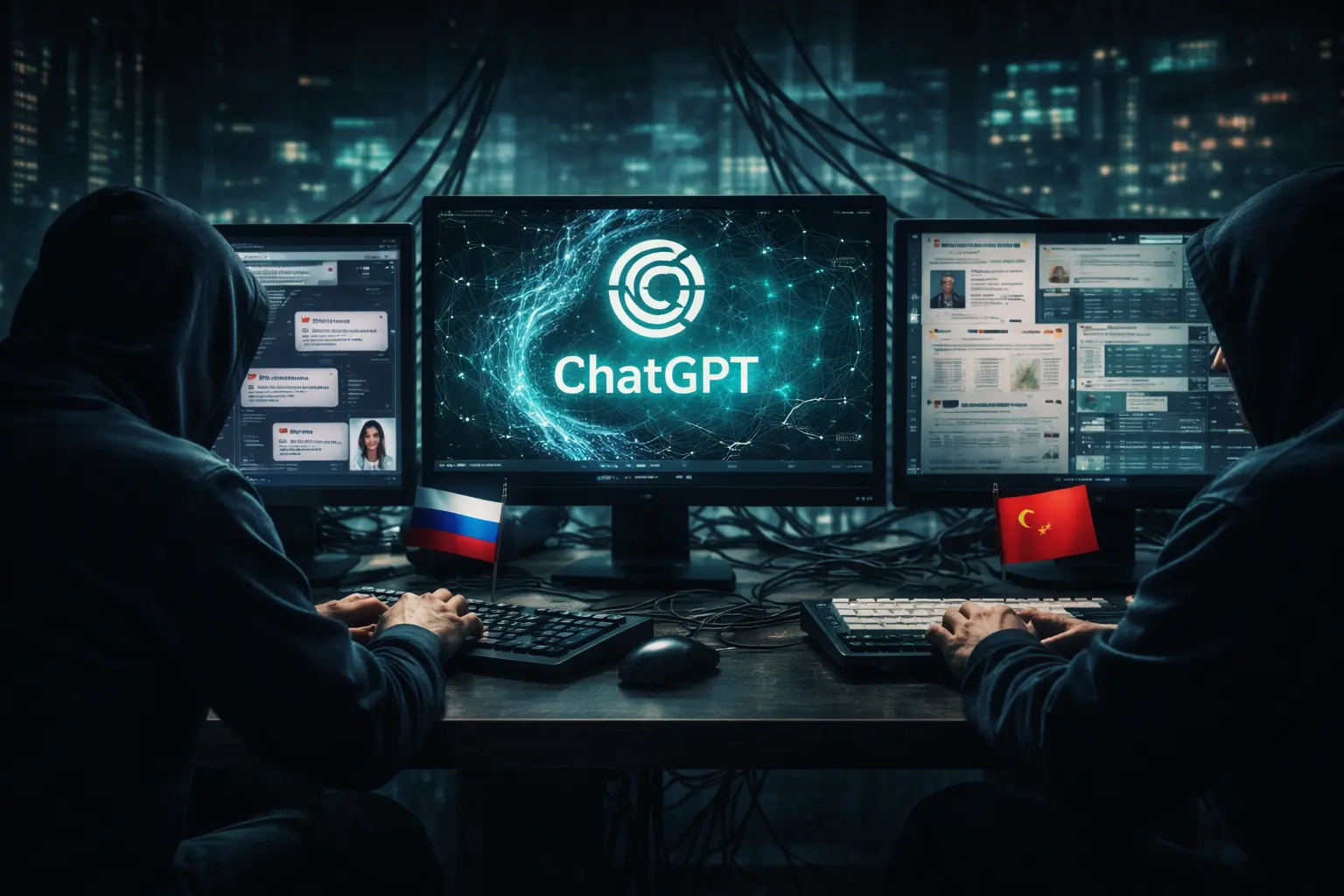
The Russia China scammers exploit ChatGPT story highlights how generative AI tools are increasingly being misused for fraud and influence operations. Recent threat intelligence findings show that organized networks linked to Russia and China used ChatGPT to produce scam content, fake documentation, and coordinated messaging campaigns. While AI systems include safeguards, determined actors continue testing their limits.
Security analysts warn that AI does not need to break into systems to cause harm. When used to automate persuasion, impersonation, and content generation, it can dramatically increase the scale and efficiency of traditional scams.
How Scammers Used ChatGPT
Investigators found that malicious actors used ChatGPT to generate high volumes of persuasive text for different fraud schemes. These included romance scams, fake investment opportunities, and so-called recovery scams targeting previous fraud victims. The AI helped draft messages that sounded natural and personalized, which increased credibility and engagement.
One network reportedly created promotional material for a fake luxury dating platform. Scammers used AI-generated content to approach wealthy individuals and build trust over time. After establishing emotional connections, they introduced financial requests disguised as investment opportunities or urgent personal needs.
In other cases, attackers generated fake legal documents and formal letters. They impersonated law firms, investigators, and financial recovery agencies. By producing professional-looking communications, they attempted to convince victims that funds could be recovered for an upfront fee.
AI did not execute the fraud directly. However, it accelerated content production and allowed operators to maintain multiple conversations simultaneously.
Influence Operations and Coordinated Messaging
Beyond financial scams, researchers observed attempts to use ChatGPT for influence campaigns. Some accounts linked to Russian and Chinese actors generated social media posts designed to shape narratives and amplify geopolitical messaging. The AI assisted with drafting comments, refining tone, and adjusting language for different audiences.
These campaigns relied on networks of accounts distributing AI-generated content across platforms. The goal was not necessarily technical compromise, but narrative control and engagement manipulation. By automating message creation, operators reduced the time and resources required to sustain coordinated activity.
OpenAI and other AI providers reported banning accounts involved in such operations. They also noted that some attempts to generate explicitly harmful or deceptive material were blocked by built-in safeguards.
Why This Matters
The Russia China scammers exploit ChatGPT case reflects a broader shift in cybercrime tactics. Generative AI lowers the barrier for producing convincing content at scale. Attackers no longer need advanced writing skills or large teams to craft persuasive scripts and documentation.
This development increases the volume and sophistication of social engineering attacks. Victims may struggle to distinguish between legitimate communication and AI-generated deception. As models improve, the line between authentic and fabricated interaction becomes harder to detect.
Organizations must respond by strengthening awareness training, verification processes, and fraud detection systems. AI vendors also face pressure to enhance misuse detection and behavioral monitoring rather than relying solely on keyword filters.
Conclusion
The Russia China scammers exploit ChatGPT story demonstrates how generative AI can amplify existing cybercrime strategies. Although AI systems include safeguards, malicious actors continue experimenting with prompt techniques to bypass restrictions. Governments, technology providers, and enterprises must adapt quickly. Without layered defenses and stronger oversight, AI-assisted fraud and influence campaigns will continue to evolve and expand.
0 responses to “Russia China scammers exploit ChatGPT to scale fraud operations”