


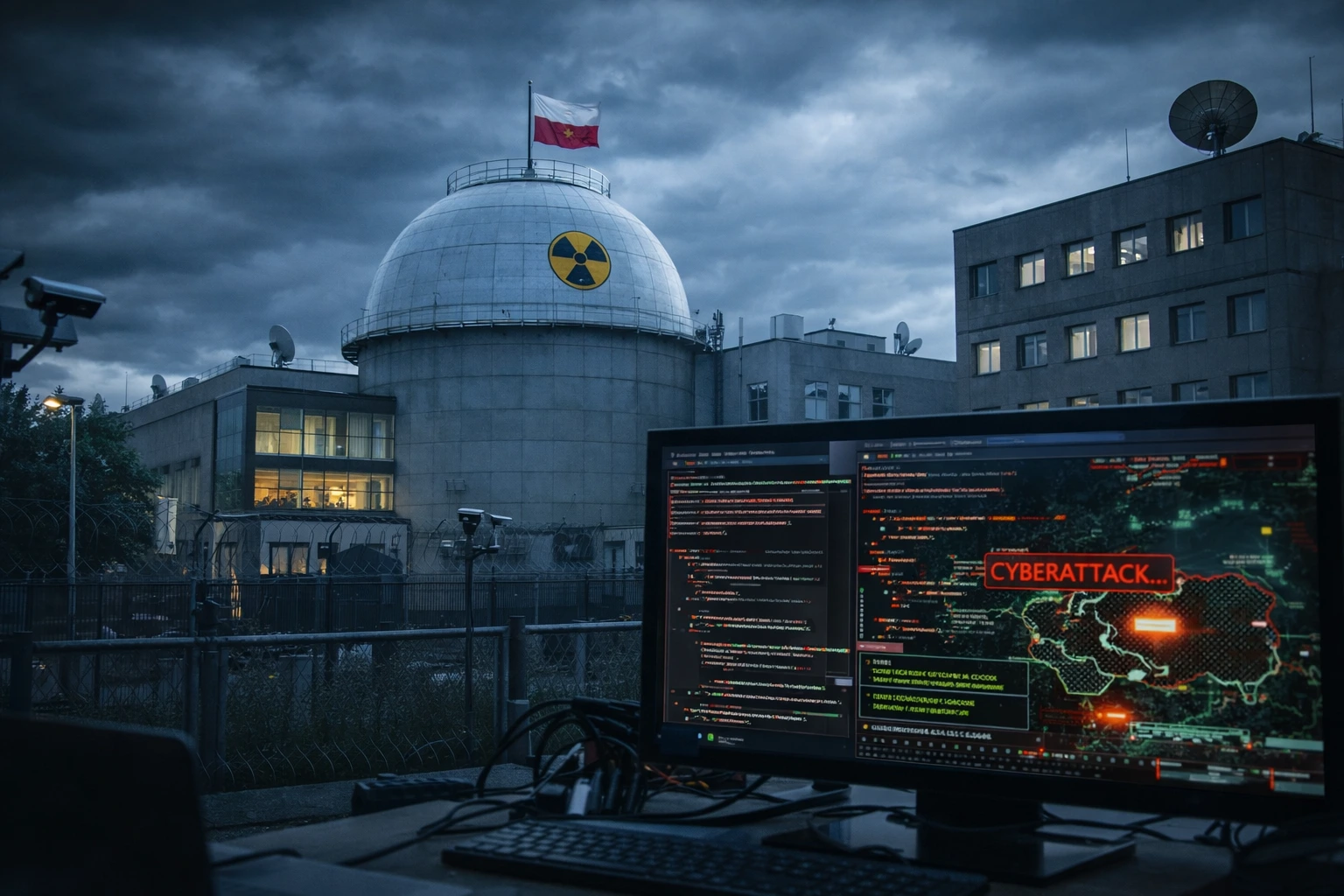
A recent cybersecurity incident targeted one of Poland’s most important scientific institutions. The Poland nuclear cyberattack involved an attempted breach of the National Centre for Nuclear Research.
Security systems detected the suspicious activity early. Internal teams quickly responded and secured the network. Officials confirmed that the attack did not disrupt operations.
The institute continues operating normally. Researchers and staff remain able to carry out their work. The incident still raises concerns about growing cyber threats targeting scientific infrastructure.
Critical research facilities now face increasing pressure from cyber attackers. These organizations hold valuable data and support national energy and security programs.
Attack Targeted Poland’s Nuclear Research Infrastructure
The attempted breach focused on the institute’s IT infrastructure. The National Centre for Nuclear Research serves as Poland’s leading nuclear science facility.
The organization conducts research in nuclear physics and reactor technology. It also develops radiation applications and scientific tools.
These activities support Poland’s long-term nuclear energy plans. The institute therefore holds strategic importance within the country’s research ecosystem.
Monitoring systems detected unusual network activity during the attack. Security teams immediately launched internal response procedures. They quickly isolated affected systems and secured the network environment.
Officials reported that attackers failed to compromise any systems. The defensive response prevented further escalation of the intrusion attempt.
Research Operations Remained Stable
Despite the attempted intrusion, research activities continued without interruption. The institute confirmed that its operations remained stable during the incident.
The facility also operates the MARIA research reactor. This reactor supports scientific experiments and produces medical isotopes used in healthcare.
Authorities confirmed that the reactor remained safe throughout the event. Safety systems and operational controls were never affected.
The institute emphasized that its cybersecurity controls functioned as designed. Early detection allowed teams to respond before attackers could access sensitive systems.
Authorities Continue Investigating the Incident
Government cybersecurity agencies are now analyzing the attempted breach. Investigators aim to determine how attackers tried to access the network.
The investigation will examine the methods used during the intrusion attempt. Officials also want to identify the origin of the attack.
Poland has experienced increasing cyber threats in recent years. Government institutions and infrastructure operators frequently face intrusion attempts.
Research organizations represent attractive targets for cyber operations. These facilities hold sensitive information and support national scientific programs.
Because of this strategic value, attackers often attempt espionage or disruption campaigns against them.
Conclusion
The Poland nuclear cyberattack highlights the persistent cyber risks facing critical research institutions. Even unsuccessful attacks demonstrate the constant pressure on scientific infrastructure.
In this case, monitoring systems detected the threat quickly. Security teams acted fast and prevented any operational damage.
Strong cybersecurity practices allowed the institute to maintain normal operations. Research activities and reactor operations continued without interruption.
As cyber threats continue evolving, protecting scientific institutions will remain essential. Early detection and rapid response will play a central role in defending critical infrastructure.
0 responses to “Poland Nuclear Cyberattack Targets National Research Centre”