


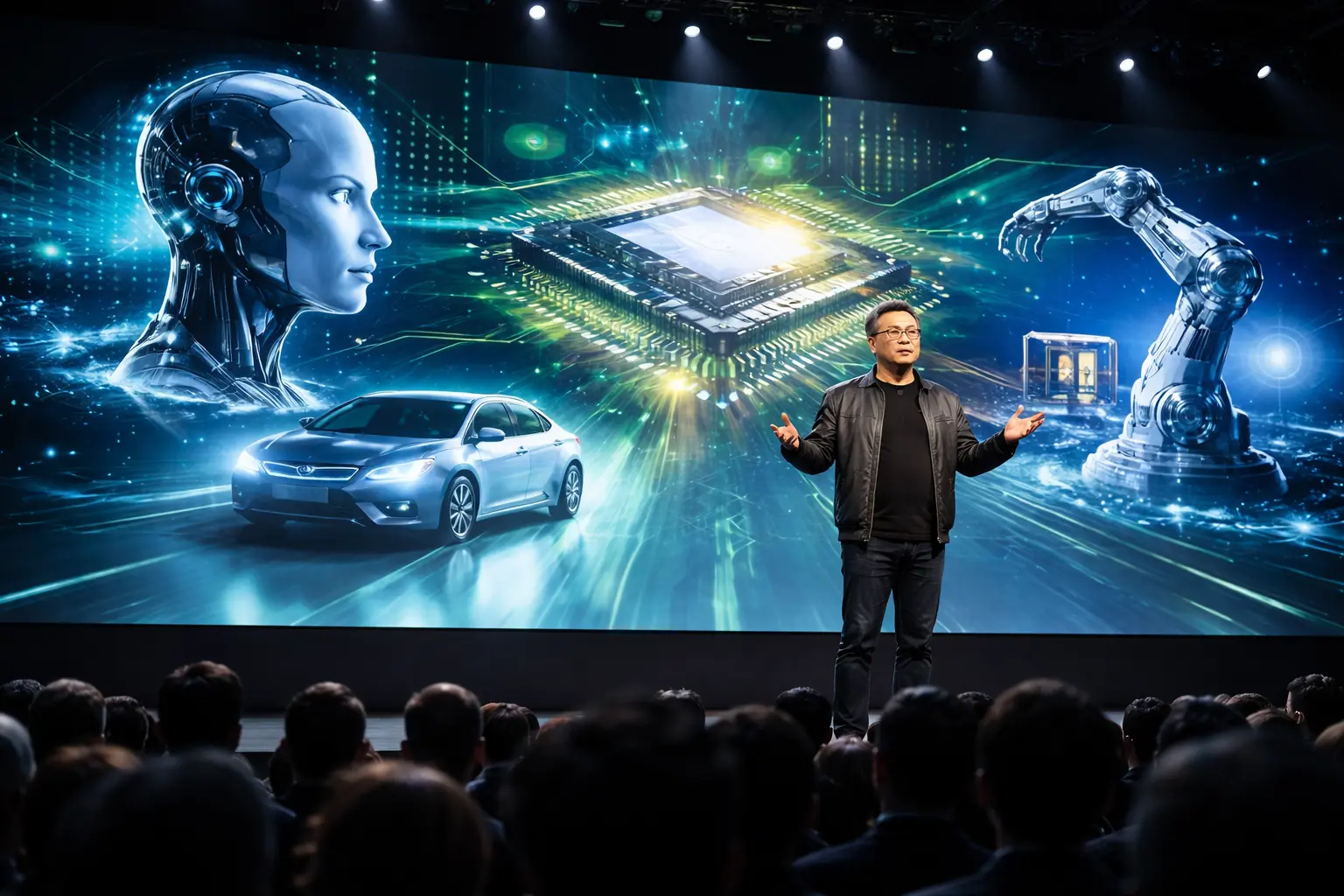
The Jensen Huang CES 2026 keynote delivered a clear message about Nvidia’s future direction. Speaking on stage in Las Vegas, the Nvidia CEO presented artificial intelligence as a foundation for physical systems, autonomous machines, and real-world deployment rather than a cloud-only technology.
Throughout the keynote, Huang positioned Nvidia as a full-stack AI company that connects hardware, software, and simulation into a single ecosystem.
Nvidia Expands AI Beyond Data Centers
During the Jensen Huang CES 2026 keynote, Nvidia emphasized its shift toward what Huang described as physical AI. Instead of limiting intelligence to servers and data centers, Nvidia plans to embed AI directly into machines that interact with the real world.
This approach relies on accelerated computing, advanced sensors, and large-scale simulation. According to Huang, the next phase of AI growth depends on systems that can perceive environments, reason about outcomes, and act autonomously.
Autonomous Vehicles Take a Central Role
Autonomous driving featured prominently in the Jensen Huang CES 2026 keynote. Nvidia introduced a new AI framework designed to handle perception, planning, and decision-making within a unified system.
Huang stressed that future self-driving platforms must explain their actions, not just execute them. Nvidia views explainable reasoning as essential for safety validation, regulatory approval, and large-scale commercial deployment.
Vera Rubin Platform Unveiled
Nvidia also used the Jensen Huang CES 2026 keynote to unveil Vera Rubin, its next-generation AI computing platform. The platform combines advanced GPUs, CPUs, networking, and security capabilities to support increasingly complex AI workloads.
Huang described Vera Rubin as a foundational platform for robotics, autonomous systems, and scientific research. Nvidia designed the architecture to scale with future AI models that require extreme performance and efficiency.
AI Positioned as Industry Infrastructure
Beyond product announcements, the Jensen Huang CES 2026 keynote framed AI as core infrastructure for multiple industries. Huang highlighted manufacturing, transportation, robotics, and healthcare as sectors that will rely heavily on AI-driven systems.
By pairing simulation with real-world data, Nvidia aims to help organizations train AI safely before deployment. This strategy reduces risk while accelerating innovation across physical environments.
Conclusion
The Jensen Huang CES 2026 keynote showcased Nvidia’s ambition to define the next era of artificial intelligence. By pushing AI into physical systems, autonomous vehicles, and next-generation computing platforms, Nvidia positions itself as a central player in the AI economy. The vision presented at CES signals a future where AI operates not only in software, but directly in the world around us.
0 responses to “Jensen Huang CES 2026 Keynote Reveals Nvidia’s AI Strategy”