


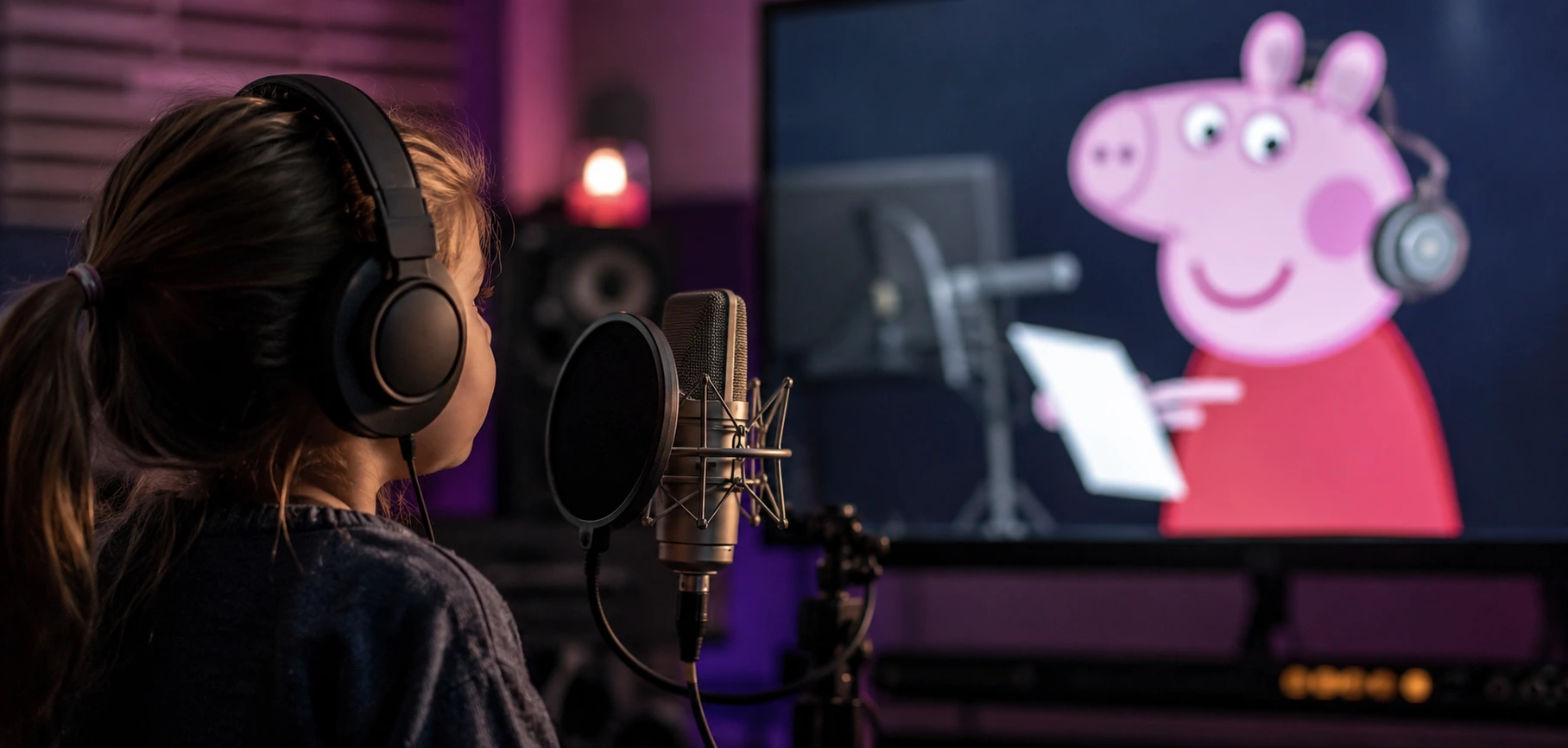
Hasbro has come under fire after reports claimed the company asks child actors auditioning for future Peppa Pig productions to sign contracts granting AI rights over their voices.
The reported Peppa Pig AI voice contract has sparked fresh debate about how entertainment companies use artificial intelligence and whether children can truly consent to agreements that may affect them for decades. Legal experts warn that AI voice licensing goes far beyond a traditional acting contract because it could allow studios to create entirely new performances long after the original actor has grown up.
Key Takeaways
- Critics have accused Hasbro of requiring child actors on Peppa Pig to accept AI voice clauses.
- Legal experts argue companies should renegotiate AI voice rights once performers reach adulthood.
- Critics warn AI could let studios continue generating new performances with childhood voices for years.
- Nearly 1,000 industry professionals have signed an open letter demanding stronger protections for child performers.
Critics Challenge Hasbro’s AI Voice Contracts
Reports claim Hasbro requires child performers to accept AI voice clauses before joining future Peppa Pig productions. Those reported provisions have prompted criticism from legal experts and performers, who argue companies should not ask children to surrender long-term rights to their voices.
Parents have always signed contracts for child actors, but AI introduces an entirely different set of risks. Instead of licensing a single recorded performance, studios can use voice cloning technology to generate unlimited new dialogue without bringing the performer back into the recording booth.
Critics say that possibility fundamentally changes the relationship between performers and production companies.
Open Letter Demands Stronger Safeguards
Nearly 1,000 performers, lawyers and entertainment professionals have signed an open letter urging studios to handle AI agreements involving children with far greater care.
Although the letter does not mention Peppa Pig directly, it makes its position clear:
“Where the performer is a child, consent must be treated with the greatest of care.”
The signatories also criticize what they describe as a “take it or leave it” approach to AI contracts. They argue studios increasingly present standard agreements that leave parents with little opportunity to negotiate important terms before signing.
Legal Experts Say AI Voice Rights Need Limits
Alan Heimlich, president of Heimlich Law, believes AI voice licensing creates legal and ethical issues that traditional acting contracts never had to address.
He argues that approving a child’s performance differs significantly from granting permanent rights to a synthetic version of that child’s voice because the agreement directly affects the performer’s future commercial identity.
“A permanent synthetic voice right, as a matter of law, impacts upon the child’s future commercial identity; whereas a parental approval of an ordinary performance would have no such impact.”
Heimlich believes every AI agreement should clearly define how long a company may use a voice model, whether it may train future AI systems with those recordings, and when those rights expire.
“At a bare minimum, there should be some form of revocation or renegotiation when the child reaches adulthood,” he says.
Without those protections, companies could continue generating new performances with childhood voice models long after performers become adults.
Could AI Force Actors to Compete Against Themselves?
Critics also worry that child actors could eventually compete against AI-generated versions of their own voices when applying for future voice acting roles.
The concern grows even greater because children’s voices naturally change throughout adolescence, while AI models can preserve a younger voice indefinitely. Animated characters such as Peppa Pig never age, but the performers behind them do.
Heimlich notes that an AI-generated voice “may continue to earn money long after the real person has undergone changes in their own identity.”
As voice cloning technology becomes more sophisticated, studios may find it increasingly difficult to distinguish authentic performances from AI-generated ones, while performers may struggle to control how companies use their voices.
Campaigners say the controversy reaches far beyond Peppa Pig. They argue studios should treat consent as an ongoing process rather than a one-time signature, particularly when AI gives companies the ability to recreate a child’s voice for years into the future.
0 responses to “Hasbro’s Peppa Pig AI Voice Contracts Spark Backlash Over Child Actors’ Rights”