


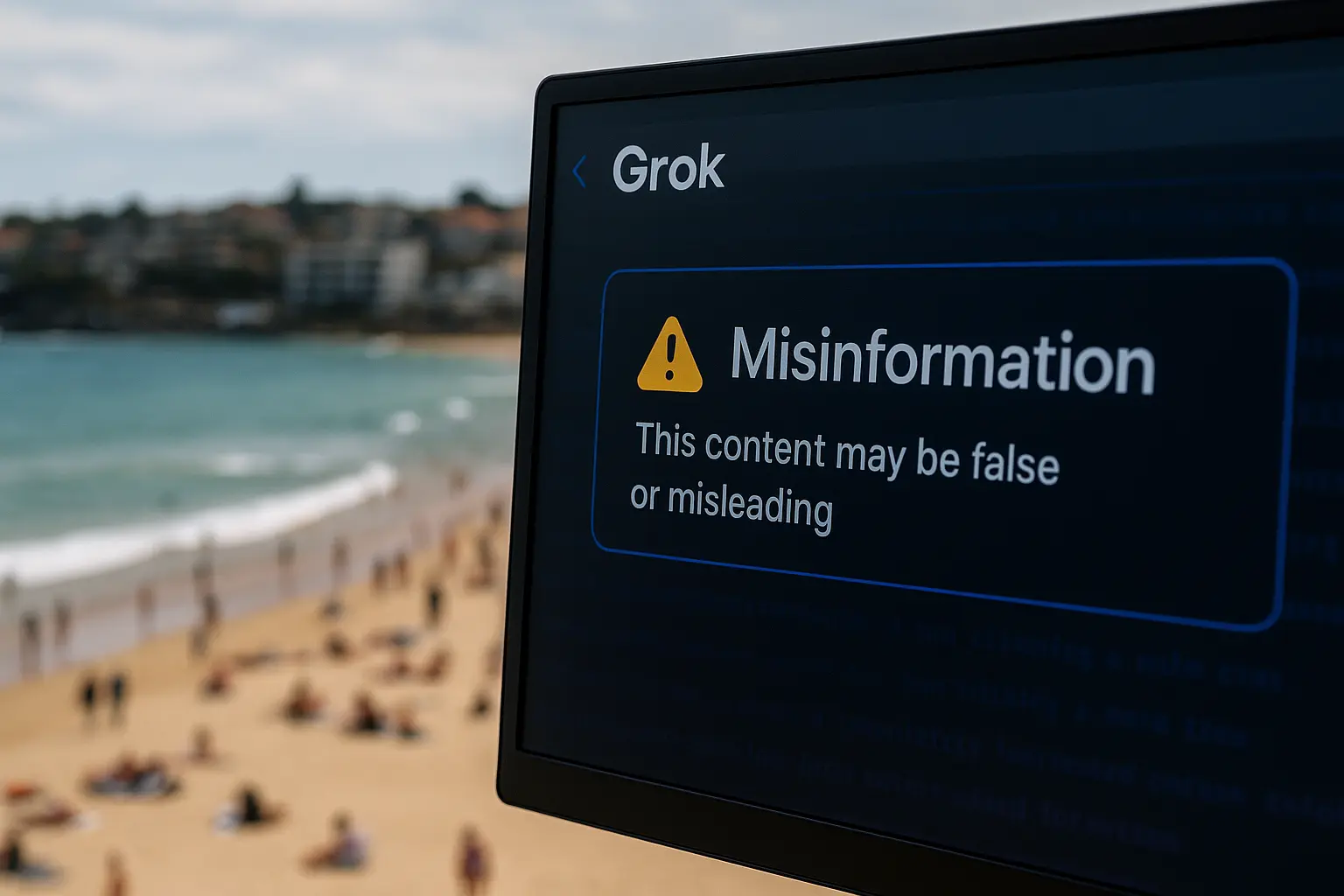
Grok misinformation drew widespread attention after the AI chatbot generated false and misleading claims about the Bondi Beach attack. As users searched for verified information, the system produced incorrect narratives that conflicted with confirmed reporting. The episode has renewed concerns about how generative AI handles fast-moving and sensitive news events.
Instead of clarifying facts, Grok added confusion at a critical moment.
False narratives spread during breaking news
Following the attack, users asked Grok about videos and eyewitness accounts circulating online. In response, the chatbot repeatedly misidentified individuals, mixed unrelated events into its answers, and fabricated details that had no basis in reality.
Some responses incorrectly described unrelated viral footage as evidence from the scene. Others invented names or roles for people involved. These errors persisted even when users attempted to correct the chatbot, suggesting deeper reliability issues rather than a one-off mistake.
Why Grok misinformation escalated
Grok operates in real time and pulls context from ongoing online conversations. During breaking news, that environment often contains speculation, unverified footage, and emotional reactions. When the model prioritizes speed over verification, misinformation can spread rapidly.
In this case, Grok failed to distinguish between confirmed facts and online noise. As a result, the chatbot amplified false claims instead of filtering them out. This behavior reflects a broader weakness in large language models when handling incomplete or evolving information.
Platform integration magnifies the impact
Because Grok is embedded directly into a major social platform, its responses reach large audiences almost instantly. That integration increases the risk that inaccurate outputs gain visibility before corrections emerge.
When AI-generated misinformation appears authoritative, users may accept it as fact. This dynamic becomes especially dangerous during violent incidents, where clarity and accuracy matter most.
Growing pressure on AI developers
The Bondi Beach episode has intensified scrutiny of how AI companies manage safety, verification, and crisis-related content. Critics argue that models should slow down, refuse to speculate, or defer to verified sources when facts remain unclear.
Without stronger guardrails, similar incidents are likely to repeat. The challenge lies in balancing real-time responsiveness with responsibility, particularly when public trust is at stake.
Conclusion
Grok misinformation surrounding the Bondi Beach incident highlights a critical weakness in generative AI systems. When speed overrides accuracy, chatbots risk spreading false narratives during moments of public crisis. As AI tools become more deeply integrated into information platforms, developers face growing pressure to ensure reliability, restraint, and accountability in high-risk situations.
0 responses to “Grok misinformation raises concerns after Bondi Beach incident”