


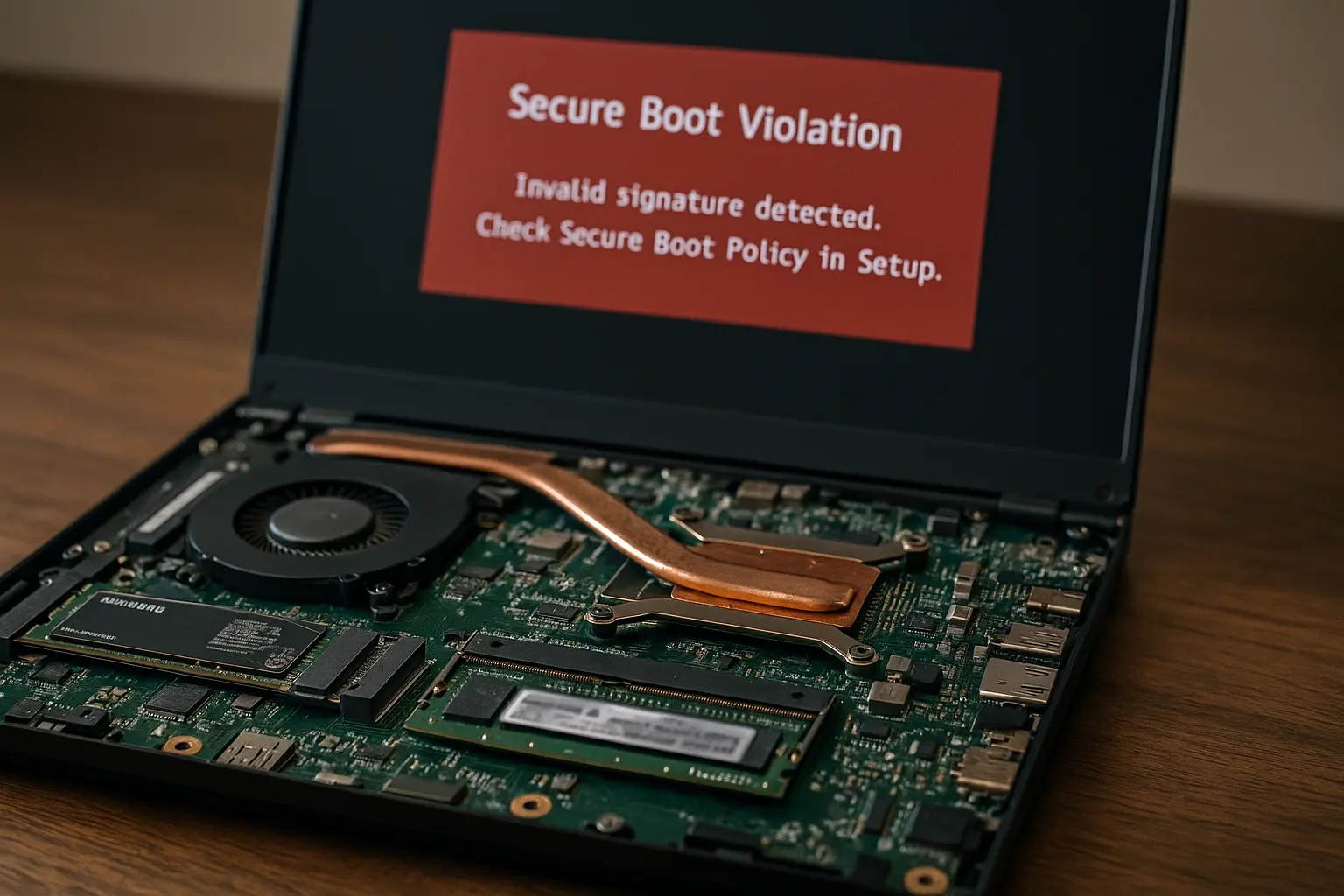
The Framework PCs Secure Boot flaw has shaken confidence in firmware-level protection across the industry. Over 200,000 Framework laptops and desktops contain a signed bypass tool that defeats Secure Boot safeguards, allowing attackers to manipulate memory before the system loads.
Secure Boot’s purpose and failure
Secure Boot exists to ensure that only trusted code runs during startup. It checks signatures to block unverified software that could hide deep within the system.
However, researchers at Eclypsium found that some Framework devices include a UEFI shell signed by Microsoft. This signed shell contains a command called “mm,” which grants direct access to system memory. That means attackers can alter critical data before the operating system starts—completely undermining Secure Boot.
How the flaw was discovered
Eclypsium identified the signed UEFI utility while analyzing Framework firmware images. Since the shell was cryptographically trusted, Secure Boot allowed it to run freely. Once loaded, the “mm” command gave users or attackers unrestricted control, enabling them to install rootkits or disable security tools without detection.
The problem lies in how trust is assigned rather than the software itself. Microsoft’s signing process validated the tool, not its intended use. That gap in verification created a serious security hole.
Framework’s response and impact
Affected models include the Framework Laptop 13, Framework Laptop 16, and the Framework Desktop—both Intel and AMD versions. Framework quickly responded with firmware updates to remove the vulnerable UEFI component.
While the company acted fast, experts warn that this issue reflects a systemic weakness in Secure Boot. Trusting signed binaries without verifying their behavior allows similar bypasses to persist across multiple vendors.
Wider implications for the industry
Secure Boot has faced repeated criticism after previous exploits like BootHole and BlackLotus. Those attacks also relied on trusted certificates to execute malicious actions before system startup.
Eclypsium emphasized that signature-based trust is not enough. Future implementations must consider function-level validation to ensure that signed tools cannot abuse low-level privileges.
Conclusion
The Framework PCs Secure Boot flaw highlights a growing concern for firmware security. It proves that signed does not always mean safe. Until trust mechanisms evolve beyond signature checks, even well-intentioned protections may remain fragile at the core of modern computing.
0 responses to “Framework PCs Secure Boot flaw exposes 200K devices”