


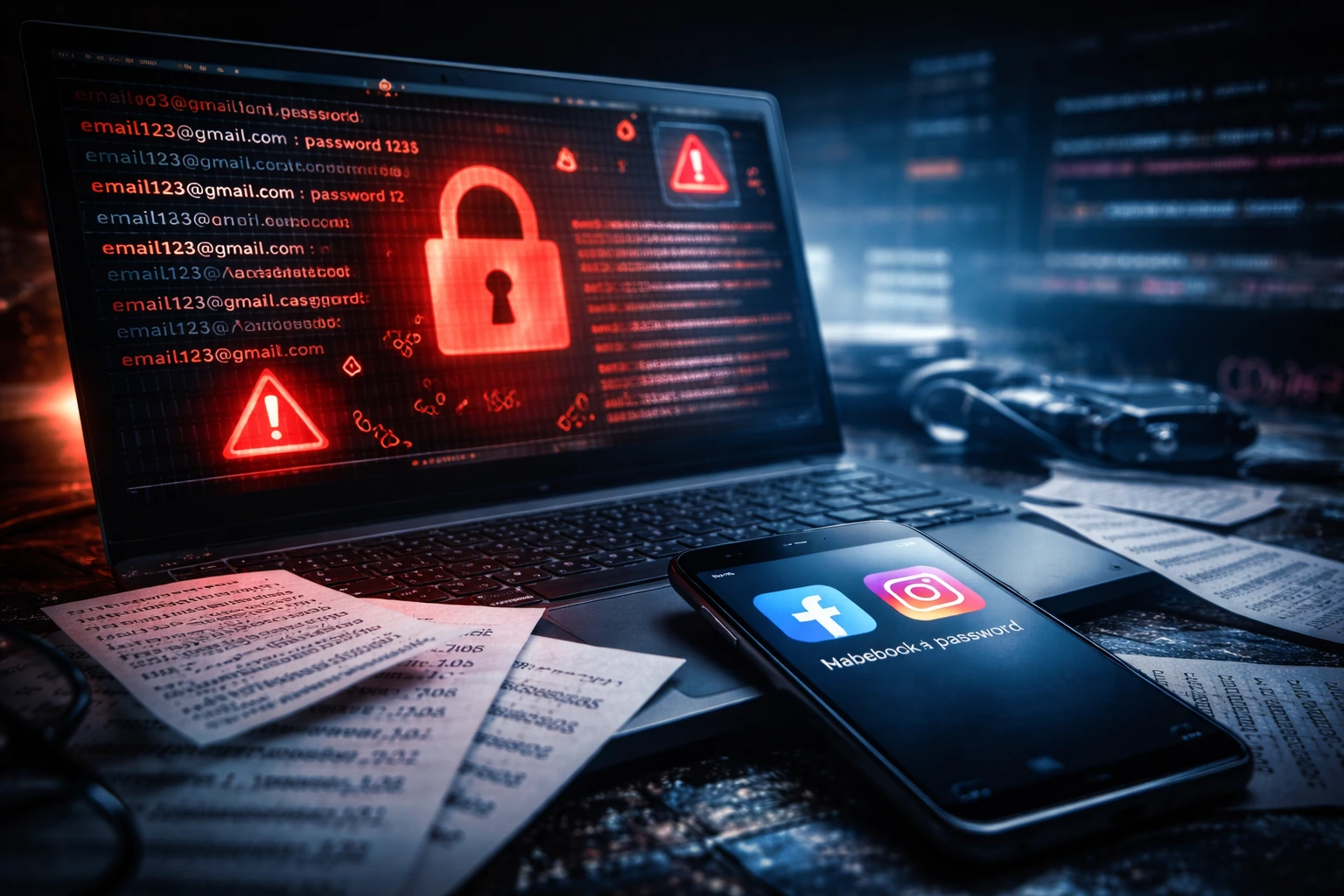
A major Facebook Instagram password leak has exposed millions of stolen login credentials after researchers uncovered an unsecured online database. The leaked records include usernames, email addresses, and passwords connected to widely used online services. The exposure creates immediate risks for account takeovers, identity abuse, and large-scale credential reuse attacks.
Although attackers did not breach Facebook or Instagram systems directly, the leaked data still puts affected users in danger. Malware-driven credential theft continues to bypass platform security by targeting users instead of infrastructure.
How Attackers Exposed the Credentials
Security researchers discovered a massive database that contained roughly 149 million login records stored without protection. The database lacked authentication, encryption, and access controls, which allowed anyone who found it to view or copy the contents.
The dataset grouped credentials by service, making it easy to identify accounts linked to Facebook and Instagram. The same collection also included credentials for email providers, streaming platforms, and financial services. This structure highlights how often users reuse passwords across multiple platforms.
The database remained publicly accessible long enough to create significant exposure risks.
Infostealer Malware Drove the Leak
Infostealer malware powered the Facebook Instagram password leak. These malicious programs infect personal devices and extract saved browser credentials, cookies, and session tokens. Attackers then aggregate the stolen data into large collections that they store, sell, or exploit.
Infostealers commonly spread through pirated software, fake updates, phishing campaigns, and malicious browser extensions. Many victims never notice the infection while attackers continue collecting sensitive data silently.
This approach allows cybercriminals to obtain valid credentials without attacking social media platforms directly.
Why the Leak Creates Serious Risk
Stolen credentials give attackers immediate access to user accounts. They can hijack profiles, reset passwords, and lock legitimate users out. Once attackers control a social media account, they often use it to spread scams or harvest more credentials.
Password reuse multiplies the damage. Attackers frequently test stolen credentials across multiple services, including email and cloud platforms. When attackers compromise an email account, they gain control over password resets and security alerts for other services.
These risks persist even when platforms enforce strong security controls.
Steps Users Should Take Now
Users should change passwords immediately on Facebook, Instagram, and any other services that use the same credentials. Enabling multi-factor authentication blocks most unauthorized login attempts, even when attackers possess valid passwords.
Running full malware scans helps identify potential infections. Using a password manager reduces future risk by generating unique credentials for every service. Users should also monitor login alerts and account activity for suspicious behavior.
Conclusion
The Facebook Instagram password leak shows how infostealer malware continues to drive massive credential exposure without breaching major platforms. Attackers increasingly target user devices rather than centralized systems. Strong password hygiene, device security, and multi-factor authentication remain essential defenses against large-scale credential theft.
0 responses to “Facebook Instagram Password Leak Exposes Millions of Stolen Credentials”