


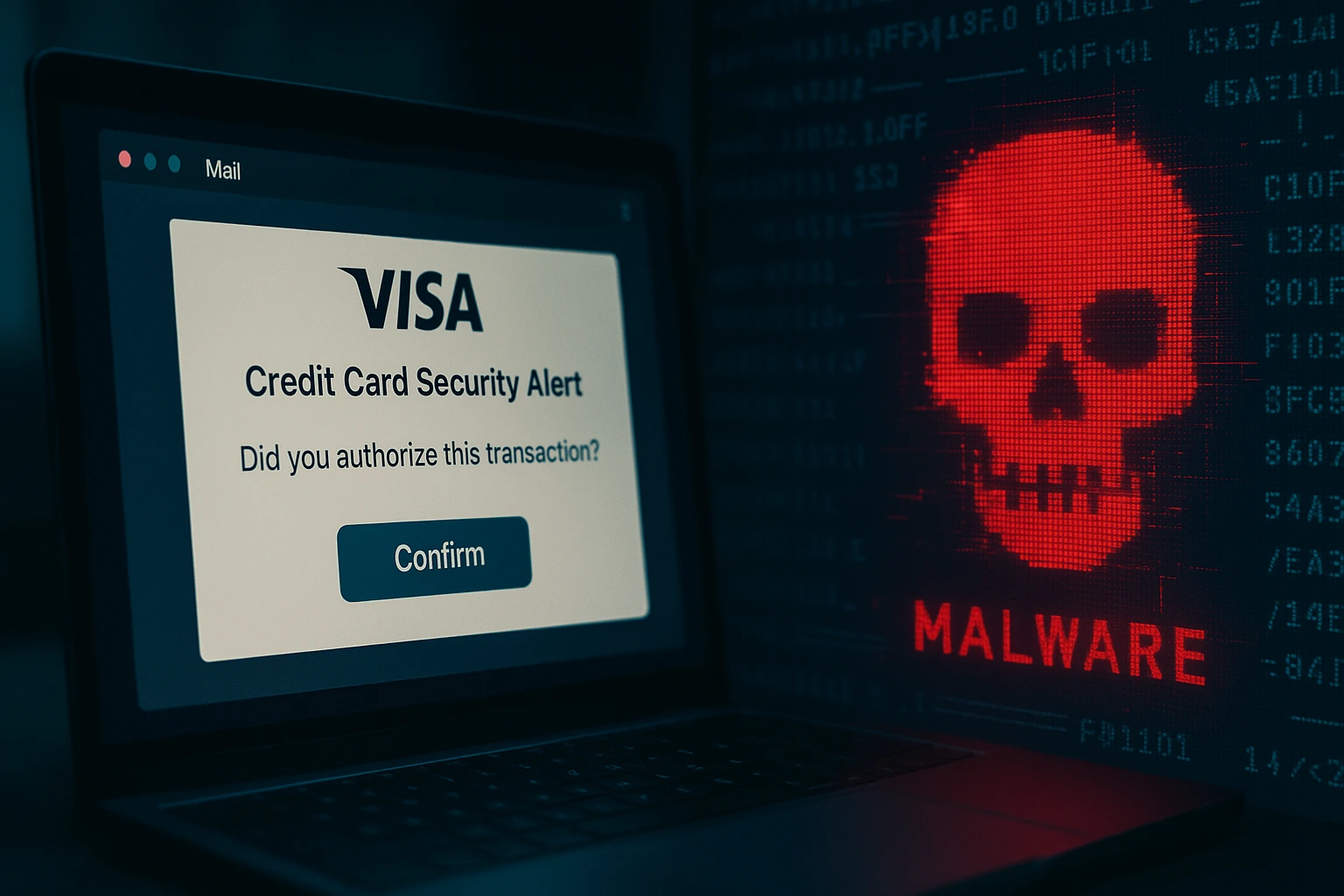
The credit card security email scam is back—and this time, it’s more dangerous than ever.
Cybercriminals are sending fake alerts that pretend to come from Visa or Mastercard. These emails ask you to confirm a suspicious purchase. But hidden inside is a malicious shortcut file (.lnk) designed to infect your system with password-stealing malware.
Fake Pop-Up, Real Malware
Victims receive what looks like a harmless HTML or security pop-up file. In reality, it’s a disguised LNK file that triggers a multi-stage attack.
When opened, the LNK file shows a fake authentication page to distract the user. In the background, it executes an HTA file. That file then drops a malicious DLL, which gets injected directly into the victim’s Chrome browser using a technique called Reflective DLL Injection.
Why This Malware Is So Dangerous
This attack is designed to run silently while stealing sensitive data. Once active, it can:
- Log everything you type, including passwords and card details
- Steal your login credentials, browser history, and saved payment data
- Maintain backdoor access to your system for future attacks
Malicious URLs Involved
Researchers at AhnLab Security Intelligence Center (ASEC) flagged these URLs used to deliver the malware:
https[:]//cdn[.]glitch[.]global/.../app64[.]loghttps[:]//cdn[.]glitch[.]global/.../main64[.]loghttps[:]//cdn[.]glitch[.]global/.../net64[.]log
Malware Attacks Are Surging in 2025
This credit card security email scam is part of a broader trend. Cybernews reports a 101.8% rise in ransomware attacks in Q1 2025 alone. Huntress also found a 104% increase in infostealer detections across 2 million endpoints.
In June, researchers uncovered a data breach involving 16 billion stolen credentials, likely linked to infostealers.
Small and mid-sized businesses are hit the hardest due to limited cybersecurity resources.
How to Protect Yourself
- Never open unexpected attachments, especially
.lnk,.hta, or.htmlfiles - Always verify the sender’s email address and domain
- Enable multi-factor authentication wherever possible
- Keep your OS, browser, and antivirus software up to date
- If something feels off, trust your instincts
Conclusion
The credit card security email scam shows how quickly a fake pop-up can become a full-blown security breach. With password-stealing malware running in the background, victims may not notice the attack until it’s too late. Stay skeptical, stay updated, and never click anything you weren’t expecting.
0 responses to “Credit Card Security Email Scam Steals Passwords Through Malware Trap”