


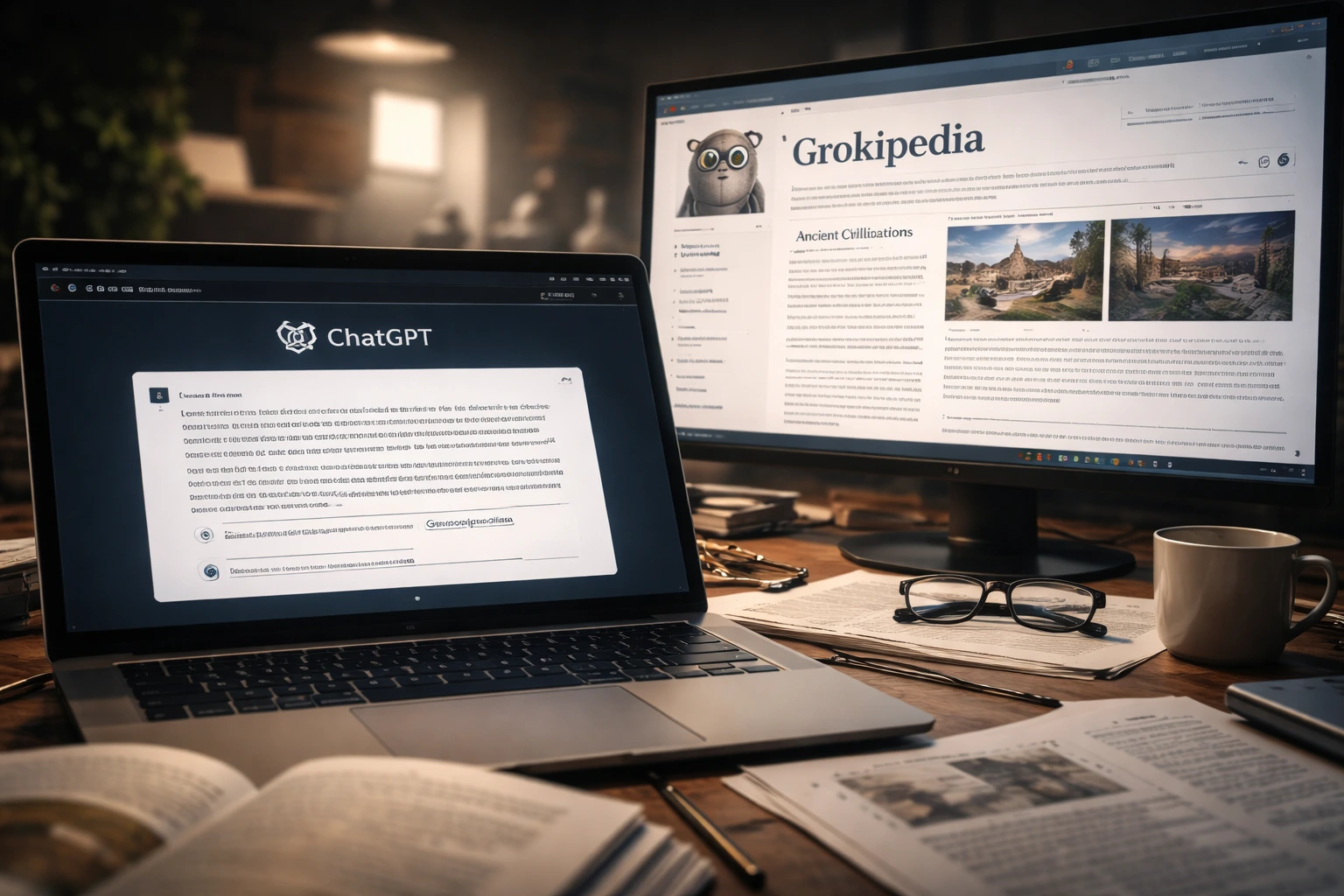
The ChatGPT Grokipedia source issue has sparked debate after users discovered that ChatGPT cited an AI-generated encyclopedia as a reference. The finding has renewed concerns about how large language models select sources and how AI-created content may influence factual accuracy.
As AI systems increasingly shape how people access information, the credibility of their underlying sources has become a critical issue.
What Grokipedia is
Grokipedia is an AI-generated online encyclopedia created by xAI, the company behind the Grok chatbot. The platform relies heavily on automated content generation rather than human editorial oversight.
Unlike traditional encyclopedias, Grokipedia does not allow community editing or transparent revision histories. Researchers have previously flagged several entries for factual inconsistencies and unclear sourcing.
These characteristics raise questions about Grokipedia’s suitability as a reference source for widely used AI systems.
How ChatGPT used Grokipedia as a source
Users testing newer ChatGPT models noticed that the system cited Grokipedia when answering certain queries. The behavior appeared more frequently with niche or less commonly searched topics.
ChatGPT did not consistently rely on Grokipedia for mainstream subjects. However, the presence of AI-generated material in its citations concerned researchers who track AI transparency and reliability.
The discovery suggests that ChatGPT may draw from a broader range of sources than users expect.
Why the ChatGPT Grokipedia source matters
The ChatGPT Grokipedia source issue highlights a growing risk in AI knowledge systems. When AI models rely on other AI-generated content, errors can compound instead of self-correct.
This feedback loop can amplify inaccuracies, reinforce bias, and reduce trust in AI outputs. Experts warn that without strong safeguards, AI systems could normalize unverified information by presenting it with authoritative tone.
The problem becomes more serious when users treat AI responses as factual references.
OpenAI’s response to sourcing concerns
OpenAI has stated that ChatGPT generates answers by synthesizing information from many publicly available sources. The company has emphasized that citations do not represent endorsements of any single source.
OpenAI also claims to apply filtering and evaluation systems to reduce misleading outputs. However, critics argue that source transparency remains limited, making it difficult for users to judge reliability.
The Grokipedia citations have intensified calls for clearer disclosure around AI sourcing practices.
Broader implications for AI development
The appearance of AI-generated sources inside other AI systems signals a shift in the information ecosystem. As more AI-created content enters the public domain, distinguishing original reporting from automated summaries becomes harder.
Developers face mounting pressure to prioritize verified sources and prevent recursive AI-to-AI sourcing. Without stronger controls, misinformation risks could rise alongside AI adoption.
Trust in AI tools depends on visible accountability and source quality.
Conclusion
The ChatGPT Grokipedia source controversy underscores the challenges of maintaining accuracy in rapidly evolving AI systems. While AI-generated encyclopedias may expand access to information, their use as references raises serious reliability concerns.
As AI models continue to influence public understanding, developers must strengthen source validation and transparency to prevent misinformation from becoming normalized.
0 responses to “ChatGPT Grokipedia Source Raises Fresh Concerns Over AI Accuracy”