


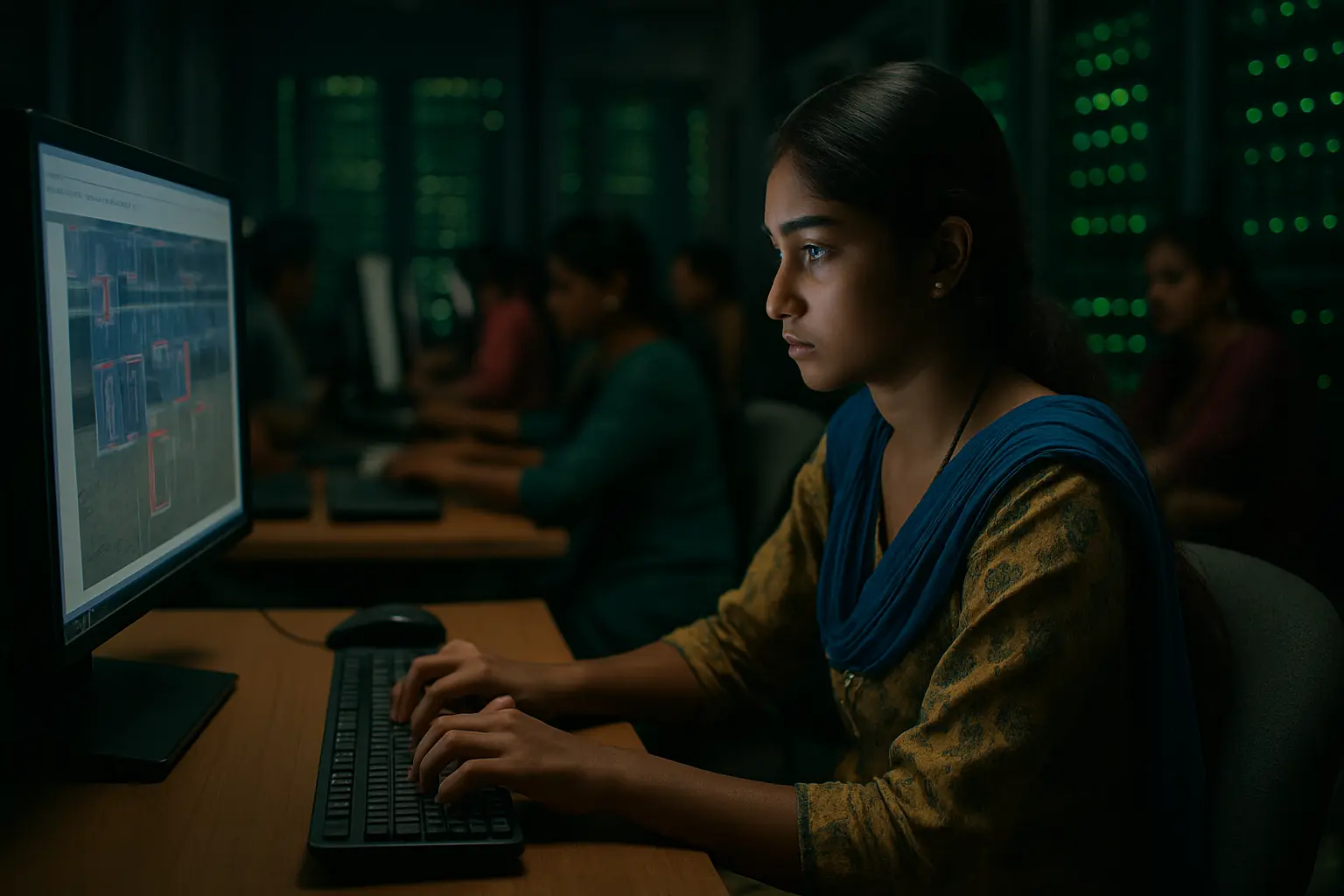
AI data centers take on an unexpected starring role as Humans in the Loop, a film about women annotating data in rural India, enters the Oscar race. The movie brings global attention to the human labor powering modern artificial intelligence, raising questions about digital work, economic inequality, and the often-ignored workforce behind AI systems.
A Film Rooted in Real-World Labor
Humans in the Loop, directed by Aranya Sahay, follows young women employed at AI data centers in rural regions of India. Their job is to annotate, label, and classify massive datasets that machine-learning models rely on. These tasks shape how AI understands images, speech, and behavior, yet the workers themselves rarely receive public recognition.
The film’s story draws inspiration from investigative reporting that documented how major technology companies outsource data-labeling operations to low-income areas. These centers provide employment, but the work often involves long hours, limited protections, and low pay, despite being essential for training advanced AI systems.
A Growing Spotlight on Invisible Digital Labor
The film captures the complexity of data-labeling work. AI data centers rely on people who process millions of data points by hand. They review images, transcribe audio, categorize objects, and refine outputs so that large models function correctly. This labor remains invisible to most users, even though it fuels breakthroughs in automation and generative AI.
By focusing on personal stories, the film reveals the emotional and psychological weight carried by workers who must meet high accuracy demands under strict deadlines. Their work forms the foundation of global AI ecosystems while rarely being acknowledged as skilled digital labor.
Recognition from the Scientific and Film Communities
The film has secured a place on the official list of Oscar-eligible titles in the Best Original Screenplay category. It also received the Sloan Distribution Grant, a prestigious award supporting films that meaningfully integrate science or technology themes. Past recipients include productions that went on to become major international successes.
This recognition signals a shift in how the creative world views AI. Stories about algorithms and automation now compete alongside mainstream dramas, illustrating how deeply AI has entered public consciousness.
A Broader Commentary on the AI Economy
Humans in the Loop raises important questions about who benefits from AI and who bears the cost. Data-annotation jobs often migrate to developing regions where labor is cheaper and oversight is weaker. This creates an imbalance in which AI data centers grow rapidly while workers operate under precarious conditions.
The film challenges audiences to confront the global supply chain behind artificial intelligence. It highlights how digital progress depends on human effort, environmental resources, and regional economic disparities.
Conclusion
AI data centers rarely appear in public conversations, yet they form the backbone of modern AI. By entering the Oscar race, Humans in the Loop brings global attention to the workers who power the industry’s most advanced technologies. As AI becomes embedded in everyday life, the film asks a fundamental question: how ethical is a system that relies on invisible labor to build intelligence for the rest of the world?
0 responses to “AI Data Centers Spotlighted as New Film Enters Oscar Race”