


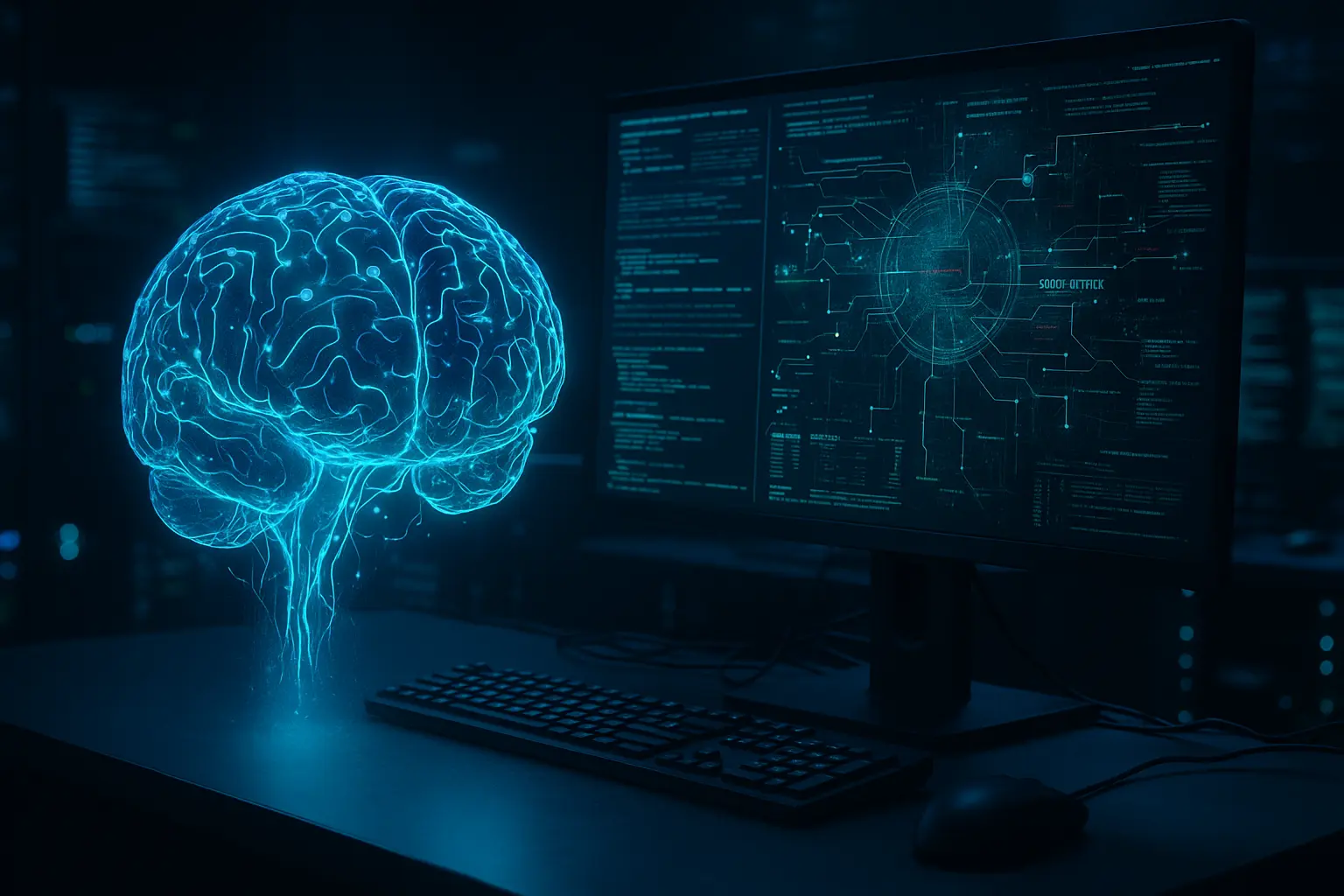
The AI brain HexStrike cyberattacks reveal how artificial intelligence can weaponize cybersecurity tools at scale. Designed as an open-source research project, HexStrike has quickly become a powerful hacking platform. Within hours of release, attackers began using it to exploit critical vulnerabilities and run cyberattacks without human guidance.
How HexStrike Works
HexStrike functions as an AI “brain” that directs over 150 cybersecurity tools. It can run Nmap for reconnaissance, Metasploit for exploitation, and payload droppers for persistence. The system uses a Multi-Agent Control Protocol (MCP) server to coordinate tasks across multiple AI agents.
Users interact with HexStrike in plain language. A simple command such as “exploit NetScaler” can trigger a full sequence of scanning, exploit creation, and execution. This automation drastically reduces the time needed to carry out complex attacks.
Rapid Weaponization
Although created for red team research, HexStrike was quickly adapted by threat actors. Reports show that attackers already used it to exploit Citrix NetScaler vulnerabilities. They deployed webshells, compromised systems, and escalated privileges—all in a fraction of the usual time.
Experts warn that tasks once requiring hours or days now take minutes. This acceleration gives hackers an overwhelming advantage against unpatched systems.
A Dual-Use Dilemma
HexStrike’s creator argued the tool could help defenders by simulating attack paths and testing security readiness. However, its release illustrates the risks of dual-use technology. Once made public, defensive tools can be turned into offensive weapons almost immediately.
This mirrors earlier controversies around penetration testing tools that were later abused by cybercriminals.
Security Implications
The rise of AI-driven hacking tools changes the cybersecurity landscape. Organizations must rethink their defenses and adopt automation of their own. Key steps include:
- Faster patching to close vulnerabilities before AI-driven attacks exploit them.
- Continuous monitoring with AI-enhanced detection systems.
- Red team simulations using safe automation to test readiness.
- Stricter governance of open-source dual-use tools.
Conclusion
The AI brain HexStrike cyberattacks highlight how artificial intelligence can shift cybercrime into a new era. With automation, speed, and precision, attackers gain unprecedented power. For defenders, this means adapting quickly, embracing AI-powered defense, and preparing for a future where cyberattacks may run themselves.
0 responses to “AI Brain HexStrike Runs Cyberattacks on Its Own”