


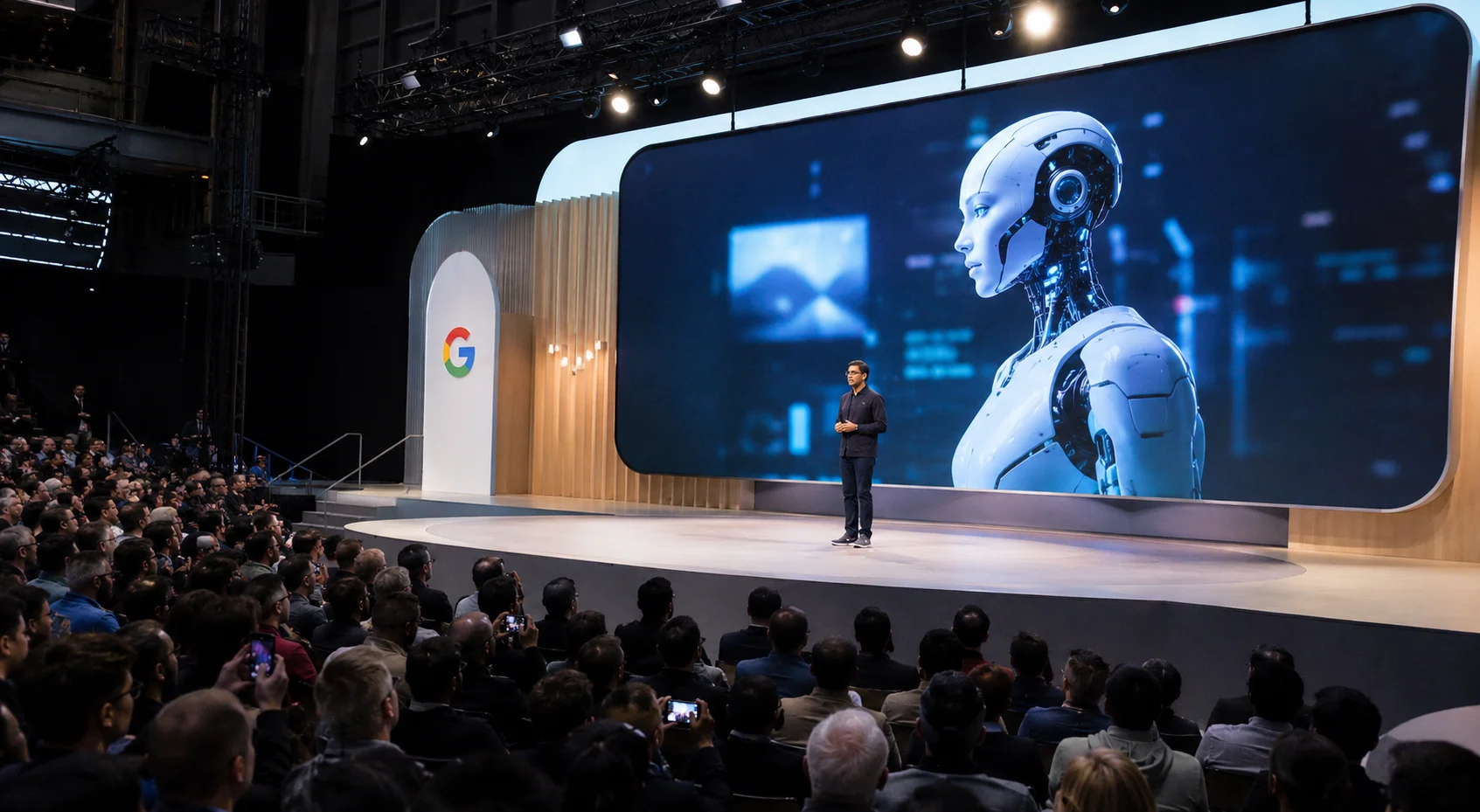
Google used I/O 2026 to push a major shift in its artificial intelligence strategy. The company introduced several new systems designed to move AI beyond simple chatbot interactions. Instead of responding to prompts alone, Google now wants AI to complete tasks, manage workflows, and operate more independently.
The event focused heavily on agentic AI, a growing category of AI systems built to reason, plan, and take action across digital environments. Google revealed Gemini Omni, Antigravity 2.0, and Gemini Spark as part of that larger push toward autonomous AI experiences.
Gemini Omni Expands Multimodal AI Capabilities
One of the biggest announcements from the event was Gemini Omni. Google described the new model family as a fully multimodal AI system capable of handling text, images, audio, and video inside a single workflow.
The first version, called Omni Flash, focuses heavily on media generation and editing. Users can reportedly create videos using prompts, photos, audio clips, or existing footage. Google also demonstrated conversational editing tools that allow users to modify generated content naturally through chat-style instructions.
The company appears to be positioning Gemini Omni as a direct competitor to advanced AI generation platforms from OpenAI and other rivals. Google also connected the model closely with products like YouTube Shorts, Flow, and the Gemini app, showing clear plans for consumer integration.
Antigravity 2.0 Targets Autonomous AI Workflows
Google also expanded Antigravity, its platform focused on building and managing AI agents. The new Antigravity 2.0 release adds stronger orchestration tools, parallel task execution, and long-running workflow support.
The platform now supports subagents, scheduling systems, project management features, and automation tools designed to reduce manual work. Google presented the platform as more than a coding assistant. Instead, the company described it as infrastructure for autonomous digital agents capable of handling complex operations independently.
Another major reveal was Gemini Spark, an always-on AI agent powered by Gemini 3.5 Flash. Spark reportedly stays active continuously and can manage emails, scheduling, productivity tasks, shopping requests, and connected workflows across multiple services.
Google also confirmed plans for third-party integrations through MCP compatibility. Early examples included productivity and commerce platforms that allow Spark to interact with external tools more directly.
Google Pushes Toward an “Agentic Gemini Era”
Google repeatedly framed the event around what executives called the “Agentic Gemini Era.” CEO Sundar Pichai explained that Gemini is evolving beyond chatbot functionality and becoming an AI system capable of taking action across products and services.
That direction appeared across several announcements during the event. Google introduced AI-powered search features, shopping tools, Workspace upgrades, and Android XR integrations designed around persistent AI assistance.
The company’s strategy reflects a wider industry race toward agentic AI systems that can complete multi-step objectives with limited supervision. However, researchers continue to warn about reliability, verification, and security challenges tied to autonomous AI behavior.
Conclusion
Google I/O 2026 showed that the company is aggressively pushing toward agentic AI experiences. Gemini Omni, Antigravity 2.0, and Gemini Spark all point toward a future where AI systems operate with far greater autonomy.
The announcements also highlight how quickly the AI industry is shifting beyond chatbots and into autonomous digital agents. As competition intensifies, companies are now racing to build AI systems capable of reasoning, creating, and acting across entire digital ecosystems.
0 responses to “Agentic AI Drives Google I/O 2026 Announcements”