


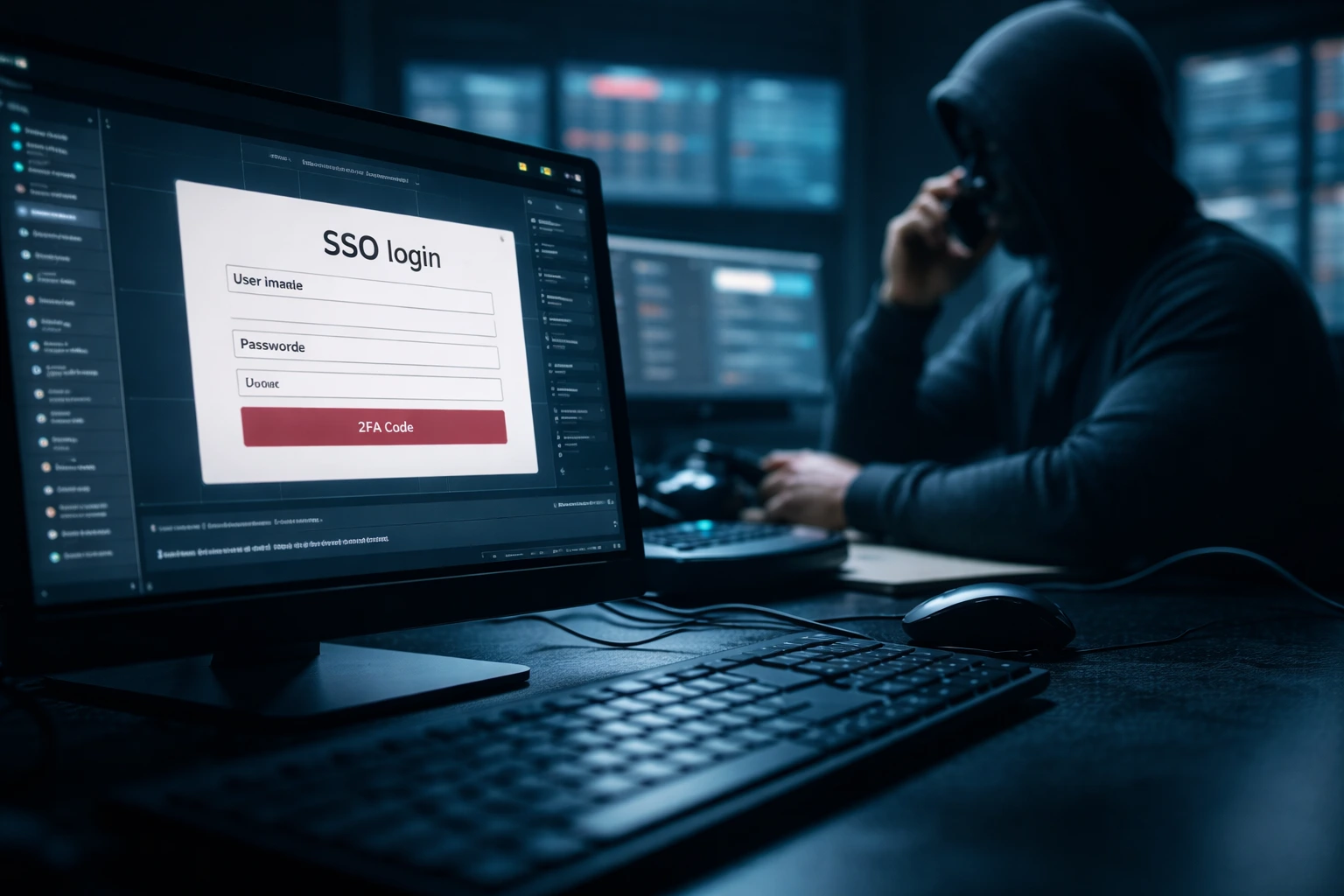
ShinyHunters SSO attacks have emerged as a serious threat to enterprise identity security. The cybercrime group claims responsibility for recent voice-phishing campaigns that trick employees into handing over single sign-on credentials, giving attackers broad access to corporate systems.
The attacks rely on social engineering rather than software exploits, showing how identity-based threats continue to evolve.
How the ShinyHunters SSO attacks work
Attackers contact employees by phone and pose as internal IT or security staff. During the call, they claim an urgent account issue requires immediate action.
The attacker then directs the victim to a fake login page that closely mirrors legitimate SSO portals. While the employee enters credentials in real time, the attacker captures usernames, passwords, and authentication responses.
This live interaction allows the attackers to bypass standard MFA protections by prompting victims to approve login requests or share one-time codes.
Why single sign-on accounts are valuable targets
Single sign-on systems centralize access across multiple services. When attackers compromise one SSO account, they often gain entry to email, cloud platforms, internal dashboards, and third-party applications.
ShinyHunters SSO attacks exploit this concentration of access. A single successful vishing call can unlock dozens of connected systems without triggering traditional security alerts.
This makes identity platforms an attractive target compared to isolated account compromises.
ShinyHunters’ claims and infrastructure
ShinyHunters publicly claimed responsibility for the campaign and stated that it operates its own phishing infrastructure. The group also confirmed ongoing efforts to monetize stolen data through extortion and leak sites.
The attackers reportedly use personal information from earlier breaches to increase credibility during phone calls. This context allows them to sound legitimate and lowers suspicion among targets.
Security researchers link these claims to broader data theft activity connected to the group.
Impact on organizations
ShinyHunters SSO attacks pose significant risks for businesses. Compromised accounts can expose sensitive communications, internal documents, and customer information.
Once inside, attackers may pivot laterally, harvest additional credentials, or prepare data for extortion. The damage often extends beyond the initial victim account.
These attacks also undermine confidence in MFA strategies that rely on user approval rather than phishing-resistant methods.
How organizations can reduce risk
Organizations should treat voice-based social engineering as a primary threat vector. Employees must understand that IT teams do not request credentials or MFA approvals by phone.
Security teams should deploy phishing-resistant MFA methods and enforce strict verification procedures for support interactions. Monitoring unusual SSO login behavior can also help detect compromise early.
Reducing reliance on user-driven approvals limits attacker success during live vishing attempts.
Conclusion
ShinyHunters SSO attacks highlight how cybercriminals increasingly target human trust rather than technical weaknesses. By exploiting voice communication and identity systems, attackers bypass controls that many organizations still consider secure.
As identity platforms become more central to enterprise operations, defending them requires stronger authentication methods, clear user training, and tighter verification processes.
0 responses to “ShinyHunters SSO Attacks Target Enterprise Accounts”