


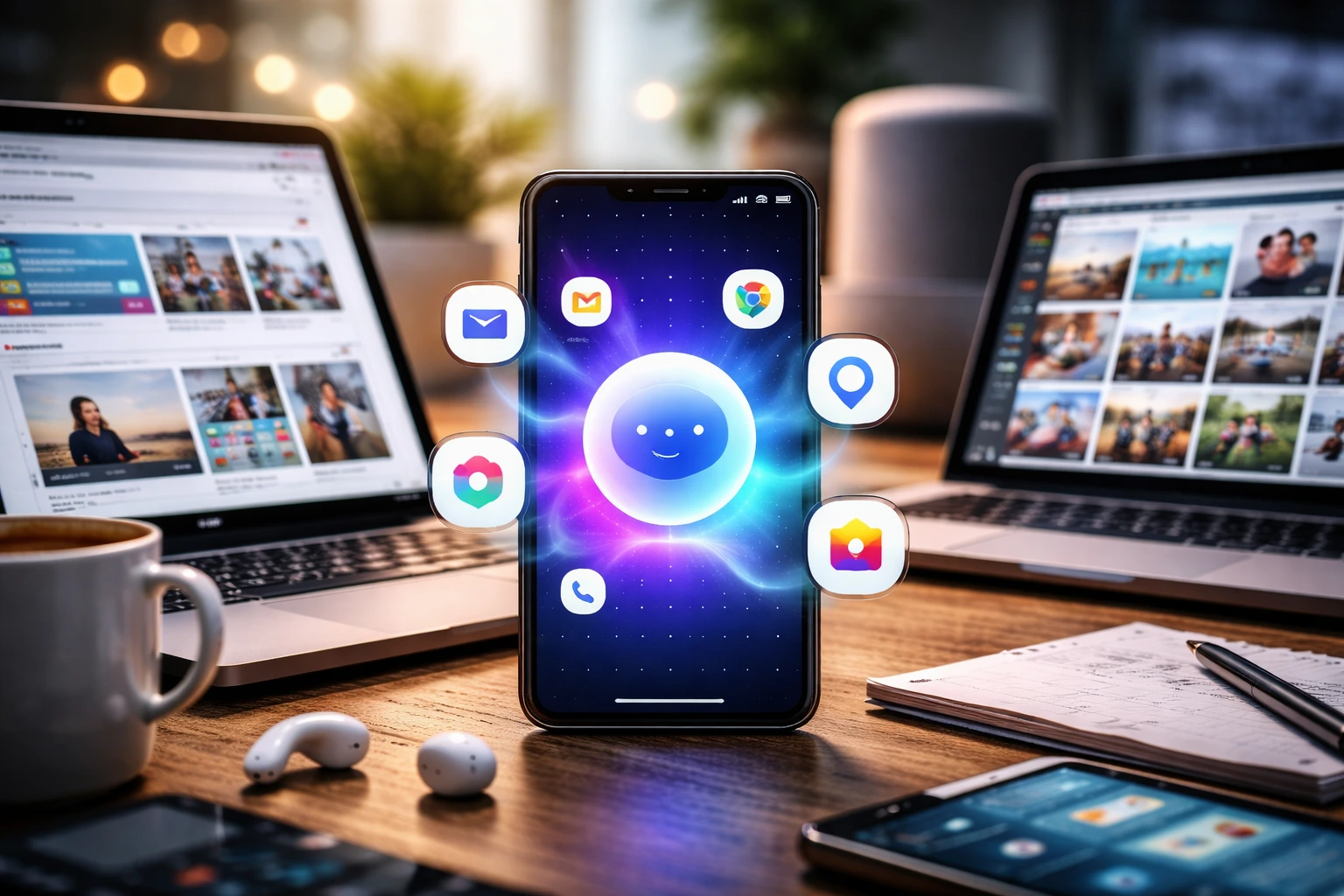
Google has introduced a new Gemini capability called Personal Intelligence, aiming to make its AI assistant more context-aware and personal. The feature allows Gemini to tailor responses using a user’s activity across Google services. This shift marks a move away from generic AI answers toward insights grounded in individual digital behavior.
The update places personalization at the center of Gemini’s evolution. By connecting multiple apps and data sources, Google wants its AI to behave more like a personal assistant than a general chatbot.
What Google Gemini Personal Intelligence does
Personal Intelligence allows Gemini to draw context from a user’s Google ecosystem. With permission, the assistant can reference Gmail messages, Google Photos, Search history, and YouTube activity. This access enables Gemini to answer questions based on personal context rather than public information alone.
For example, users can ask Gemini to locate details buried in past emails or recall information tied to photos or searches. Gemini can combine these signals to deliver responses that reflect real user activity.
This approach allows the assistant to understand intent more accurately and reduce repetitive back-and-forth questions.
How personalization changes Gemini’s responses
Traditional AI assistants respond using static knowledge or real-time web data. Personal Intelligence changes this model by grounding answers in personal history. Gemini can identify patterns across apps and infer relevance based on past behavior.
The system does not simply retrieve data. It reasons across multiple sources to generate useful responses. This reasoning capability allows Gemini to connect information that users may not consciously link themselves.
As a result, Gemini’s answers feel more specific, timely, and relevant to each user.
User control and privacy considerations
Google positions Personal Intelligence as an opt-in feature. Users choose which apps Gemini may access and can revoke permissions at any time. The assistant only uses connected data to respond to user-initiated requests.
Despite these controls, the feature raises important privacy questions. Combining email content, photos, and search behavior creates a detailed personal profile. Even with safeguards, users must trust that access remains limited and transparent.
Google states that users retain control over their data and can manage connections through account settings.
Availability and rollout strategy
Google has begun rolling out Personal Intelligence as a limited feature tied to paid Gemini plans. The company plans a gradual expansion to additional regions and users. This phased approach allows Google to refine the system before broader adoption.
The rollout also reflects competition in the AI assistant market. Tech companies increasingly focus on personalization as a differentiator rather than raw model performance.
Google’s advantage lies in its vast ecosystem of consumer services.
Why this feature matters
Personal Intelligence signals a broader shift in AI development. Assistants no longer aim to answer questions alone. They aim to understand users and anticipate needs based on context.
This direction could redefine how people interact with AI in daily life. Scheduling, planning, searching, and recalling information may become more seamless and proactive.
At the same time, deeper personalization increases responsibility around data handling and transparency.
Conclusion
Google Gemini Personal Intelligence represents a major step toward deeply personalized AI assistance. By connecting Gmail, Photos, Search, and other services, Gemini can deliver context-aware responses that feel tailored and practical. As Google expands access, the feature may reshape expectations for how personal an AI assistant can become while keeping user control at the center.
0 responses to “Google Gemini Personal Intelligence brings deep personalization to AI”