


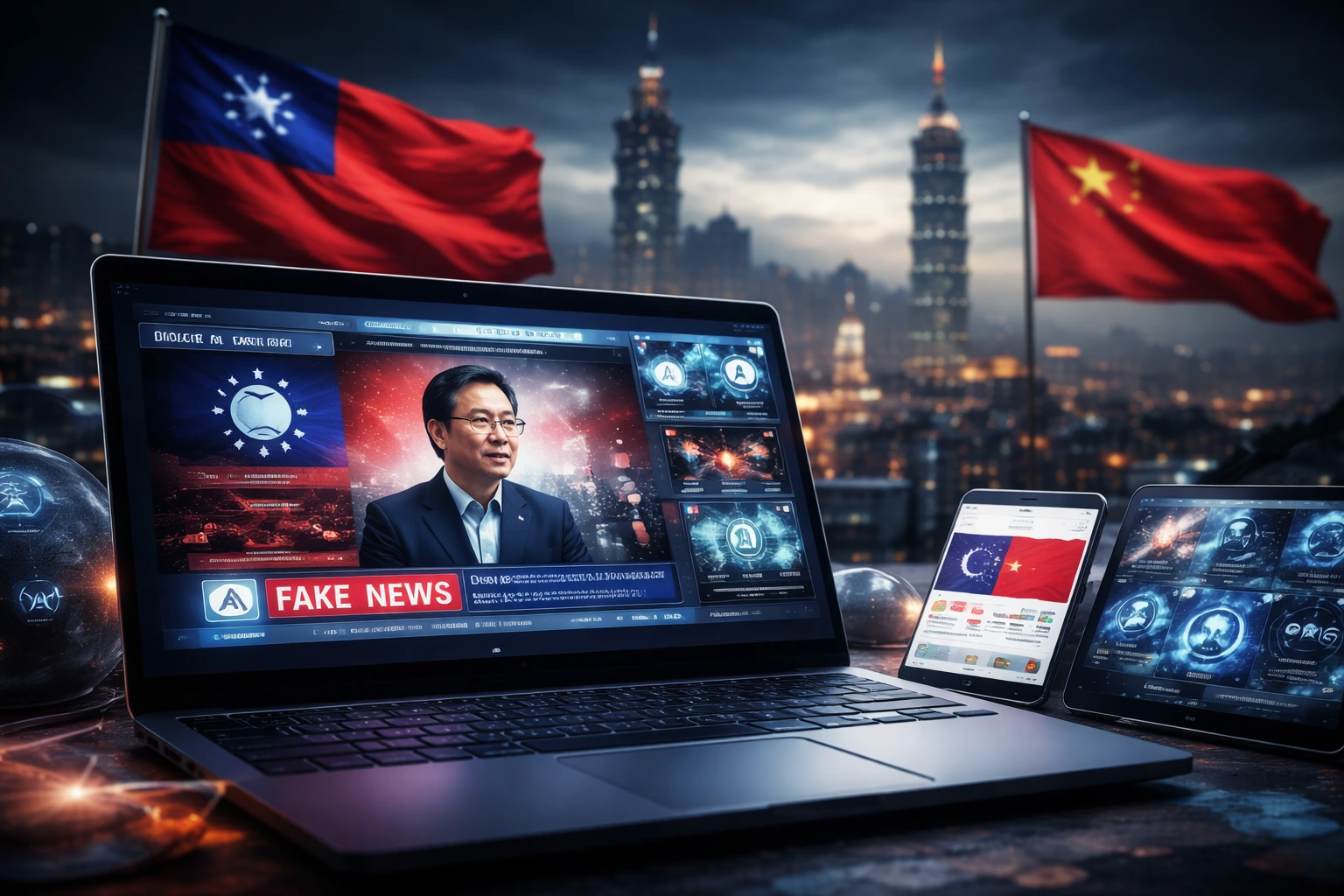
China has intensified its information warfare against Taiwan by deploying AI-generated content and deepfake media as part of a broader influence campaign. Taiwanese security officials warn that these operations aim to manipulate public opinion, undermine trust in democratic institutions, and weaken international support for the island. The growing scale and sophistication of the activity marks a shift in how digital influence campaigns are conducted.
Authorities say the use of artificial intelligence allows these efforts to operate faster, cheaper, and with greater reach than traditional disinformation methods. The result is a constant stream of misleading content that blends seamlessly into online discussions, making detection increasingly difficult.
How China is using AI and deepfakes
According to Taiwan’s National Security Bureau, China relies heavily on AI tools to generate convincing fake content at scale. This includes deepfake videos, synthetic voice recordings, and AI-written posts designed to mimic real users. Many of these materials are spread through social media platforms, messaging apps, and cloned news websites that imitate legitimate outlets.
The campaigns often focus on politically sensitive topics, including elections, national security, and relations with the United States. By flooding online spaces with conflicting narratives, the goal is not always persuasion but confusion, fatigue, and distrust.
Officials also report the widespread use of fake accounts that appear authentic, complete with profile histories and coordinated posting behaviour. These accounts amplify divisive narratives while posing as ordinary Taiwanese citizens.
Outsourcing and automation increase scale
One of the most concerning developments is the outsourcing of influence operations to private Chinese technology and marketing firms. These companies allegedly manage large networks of automated accounts and content pipelines, allowing campaigns to run continuously with minimal human oversight.
AI automation enables rapid adaptation to current events. When news breaks, disinformation narratives can be generated and deployed within minutes. This speed gives defenders little time to respond before false narratives gain traction.
The scale of these operations suggests long-term strategic planning rather than isolated incidents.
Digital influence tied to military pressure
Taiwanese officials stress that AI-driven disinformation campaigns do not occur in isolation. They often coincide with Chinese military exercises, diplomatic pressure, and cyber activity. This coordinated approach blends psychological, informational, and physical pressure into a single strategy.
During periods of heightened military activity, online narratives frequently attempt to portray Taiwan’s leadership as weak or reckless. Other messages seek to discourage international allies by questioning Taiwan’s stability or reliability.
Security analysts describe this as cognitive warfare designed to shape perceptions before any physical conflict occurs.
Why the threat is hard to counter
AI-generated content presents unique challenges for detection and enforcement. Deepfakes continue to improve in quality, while AI-written text avoids many of the linguistic markers used to identify automated activity. Even experienced users may struggle to distinguish real content from fabricated material.
Platform moderation tools often lag behind these advances. By the time content is flagged, shared narratives may already be widely accepted or emotionally reinforced.
This makes public awareness and media literacy a critical part of national resilience.
Conclusion
China AI deepfake campaigns targeting Taiwan demonstrate how modern influence operations are evolving through automation and artificial intelligence. By combining deepfakes, fake personas, and coordinated amplification, these efforts aim to distort reality and erode trust at scale. As digital manipulation becomes more sophisticated, defending against it will require faster detection, stronger public awareness, and coordinated international responses.
0 responses to “China AI deepfake campaigns target Taiwan’s public opinion”