


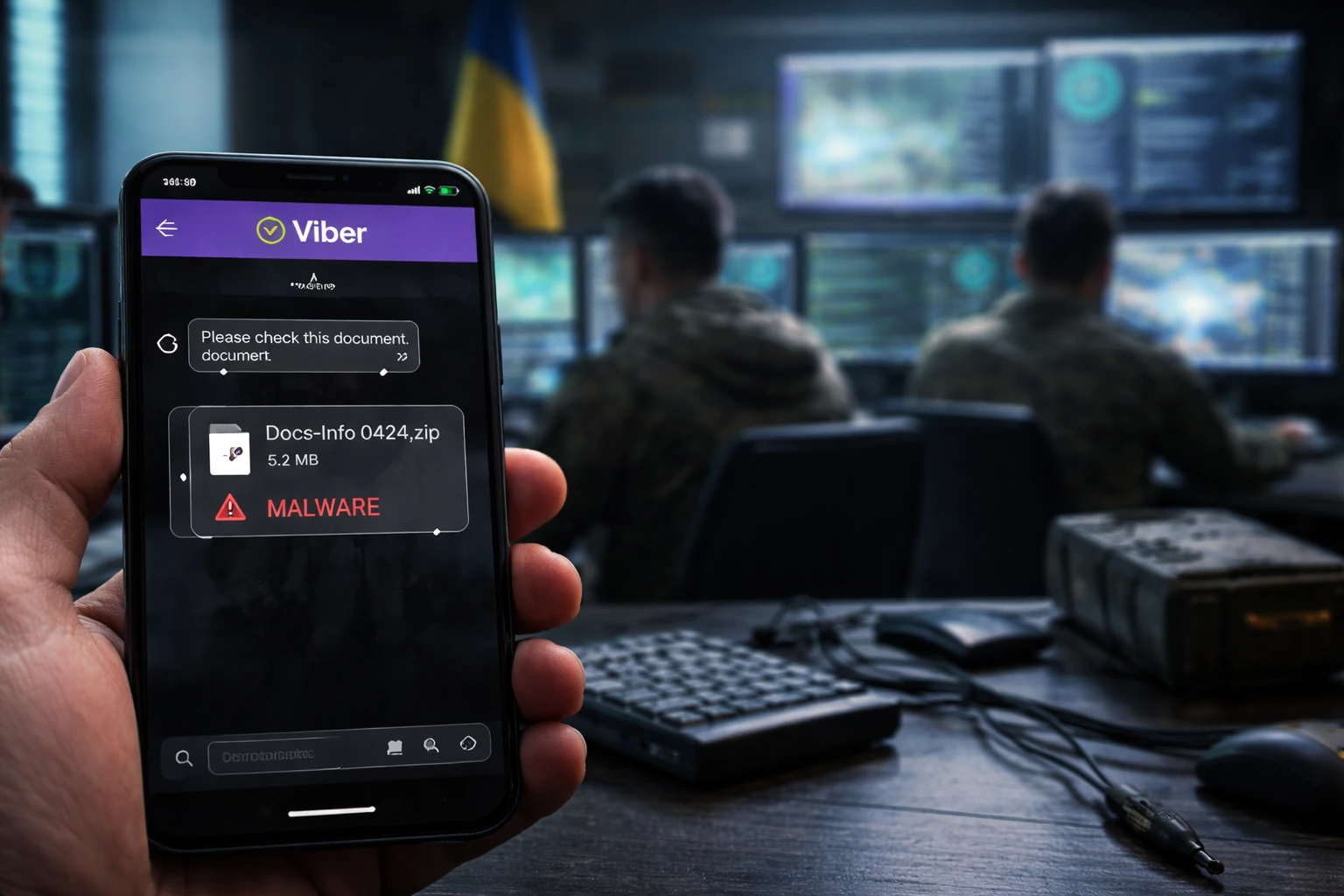
Russia-aligned hackers have launched a targeted cyber campaign against Ukraine using an unexpected delivery channel. The Viber malware attack Ukraine highlights how threat actors now exploit trusted messaging platforms for cyber espionage.
Instead of relying on email phishing, the attackers used direct Viber messages. This tactic increased credibility and reduced suspicion among recipients.
Who Is Behind the Attack
Security researchers link the campaign to the Russia-aligned threat group known as UAC-0184. The group has repeatedly targeted Ukrainian military and government organizations.
UAC-0184 focuses on intelligence collection rather than financial crime. The latest operation fits its established espionage-focused activity.
How the Viber Malware Attack Works
The attackers sent malicious files directly through Viber chats. They disguised the files as legitimate documents and shared them using convincing pretexts.
When victims opened the files, the malware executed immediately. The payload granted attackers remote access to infected systems and enabled ongoing monitoring.
This approach allowed the attackers to bypass many traditional email-based security controls.
Why Viber Became the Delivery Channel
Viber plays a central role in everyday communication across Ukraine. Many military and government personnel rely on the platform for fast coordination.
Messages received through familiar apps often appear more trustworthy. The attackers exploited that trust to increase engagement and infection rates.
The campaign shows that messaging platforms now face the same abuse risks as email.
Targets and Objectives
The Viber malware attack Ukraine focused on high-value targets rather than mass distribution. The attackers selected military units, government agencies, and related institutions.
Researchers believe the operation aimed to collect sensitive intelligence. Access to internal communications would offer strategic insight into operations and planning.
Technical Behavior of the Malware
The malware operated quietly to avoid detection. It minimized system disruptions and avoided obvious performance issues.
After installation, it maintained long-term persistence. This design allowed the attackers to observe activity over extended periods without alerting users.
Such behavior aligns with espionage-driven malware campaigns.
Broader Cyberwarfare Context
This attack reflects a broader shift in cyberwarfare tactics. Threat actors increasingly blend into normal digital behavior instead of relying on noisy exploits.
As defenses improve, attackers adapt by abusing trusted services. Messaging platforms now represent a growing attack surface in state-linked cyber operations.
Ukraine continues to face sustained cyber pressure alongside ongoing geopolitical conflict.
How Organizations Can Reduce Risk
Users should treat unexpected files cautiously, even when they arrive through familiar messaging apps. Trust in the platform does not guarantee file safety.
Organizations should limit file execution and enforce strict endpoint controls. Regular security awareness training helps users recognize social engineering attempts.
Active monitoring of endpoint behavior can also expose suspicious activity early.
Conclusion
The Viber malware attack Ukraine demonstrates how easily threat actors can weaponize trusted communication tools. By exploiting a widely used messaging app, attackers gained access to sensitive targets while avoiding common defenses.
As cyber threats evolve, defenders must secure every communication channel. Messaging platforms now demand the same scrutiny as email and web traffic.
0 responses to “Viber malware attack Ukraine targets military and government”