


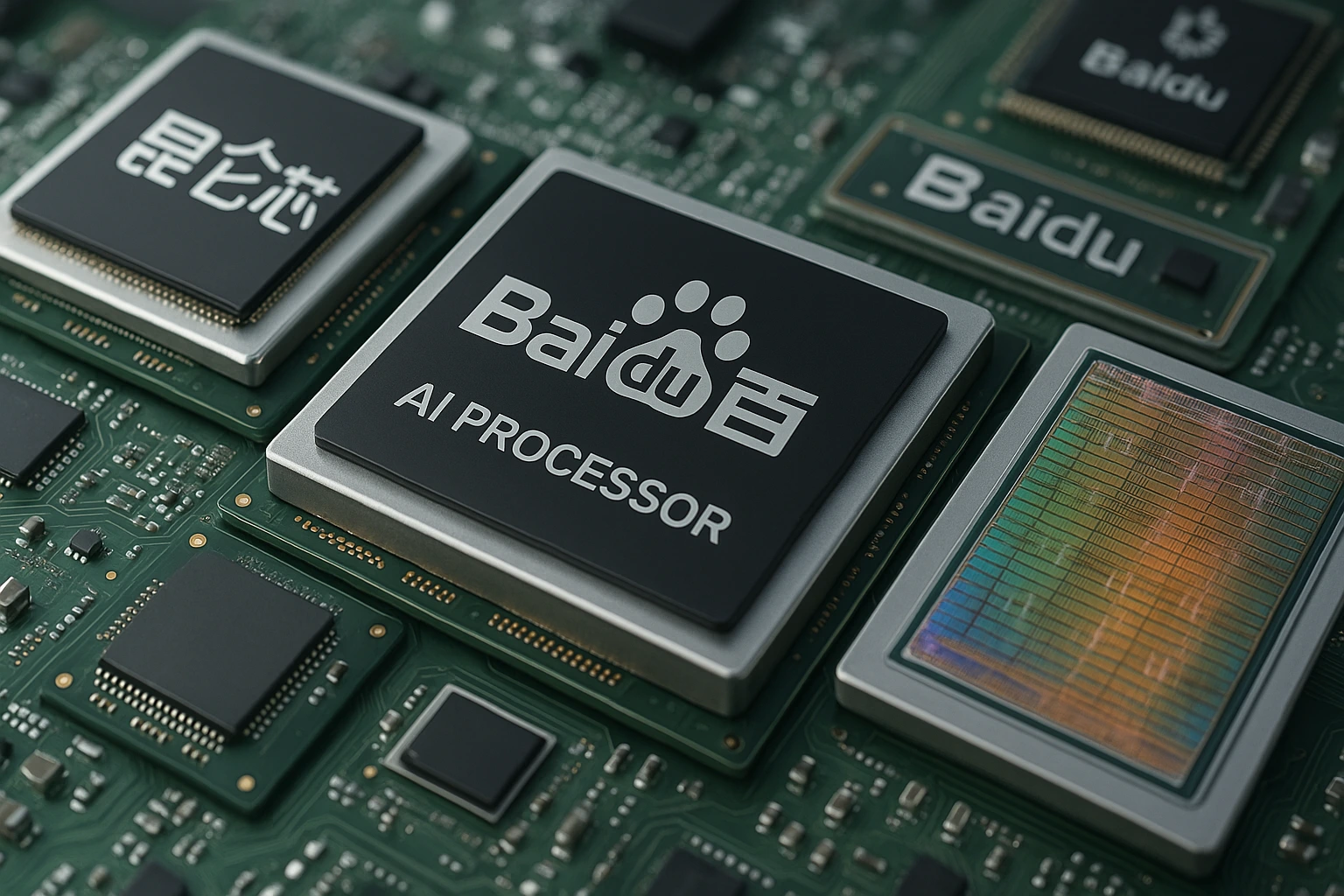
Baidu has unveiled new AI processors and supercomputing hardware designed to reduce China’s reliance on foreign chips. The move comes as US export restrictions continue to limit access to advanced semiconductor technology. With the launch, Baidu positions itself as a stronger competitor to Nvidia and Huawei in the race for high-performance AI hardware.
New chips designed for high-performance AI workloads
The new Baidu AI processors support training and inference for large-scale models, including next-generation multimodal systems. Baidu says the hardware offers improved performance per watt and higher bandwidth for demanding AI applications. These benefits target enterprise customers and cloud providers that need scalable resources for real-time computing.
The accompanying supercomputing architecture is built to manage dense clusters of AI accelerators. It features optimized cooling, faster interconnects, and an upgraded software stack that supports parallel training. Together, the processors and infrastructure aim to deliver competitive performance without relying on foreign chipmakers.
Baidu challenges Nvidia and Huawei amid restrictions
The Baidu AI processors arrive at a moment when Nvidia faces strict US export controls on advanced chips bound for China. This has opened opportunities for domestic firms to fill the gap. Baidu, Huawei, and other Chinese vendors are now racing to produce accelerators that meet local demand for AI growth.
Although Nvidia still dominates global AI hardware, China’s restrictions create a new market dynamic. Baidu sees this as a chance to build a larger share of the enterprise and government sectors, where reliable local supply chains are increasingly critical. The company’s latest processors also compete directly with Huawei’s Ascend series, which remains a leading domestic platform.
Strengthening China’s supercomputing ecosystem
These developments support China’s strategic goal of building a self-sufficient computing ecosystem. The country has invested heavily in its semiconductor supply chain, from manufacturing to packaging and cloud-scale infrastructure. Baidu’s new chips add momentum by offering another homegrown alternative for high-performance computing.
However, the company still faces challenges. Advanced semiconductor fabrication remains difficult without access to cutting-edge US technology. Therefore, Baidu must optimize performance using limited manufacturing options, creative software design, and efficient system integration.
Enterprise adoption and future direction
Baidu expects strong demand from companies deploying large language models, video-analysis tools, and industrial AI systems. The processors are also intended to power Baidu’s own model development pipeline, which requires rapid scaling to stay competitive.
Analysts say Baidu’s progress will depend on how well the chips perform in real-world workloads compared to Nvidia GPUs. Cost, availability, and software ecosystem quality will also influence adoption. As China pushes for domestic chip independence, Baidu’s success could shift the balance of its AI industry.
Conclusion
The introduction of Baidu AI processors marks a significant step in China’s push for chip sovereignty. By expanding its hardware portfolio, Baidu aims to compete more directly with Nvidia and Huawei while strengthening the country’s AI infrastructure. As export restrictions continue, domestic innovation will play a larger role in shaping the future of China’s AI growth.
0 responses to “Baidu AI processors debut as China strengthens domestic chip capabilities”