


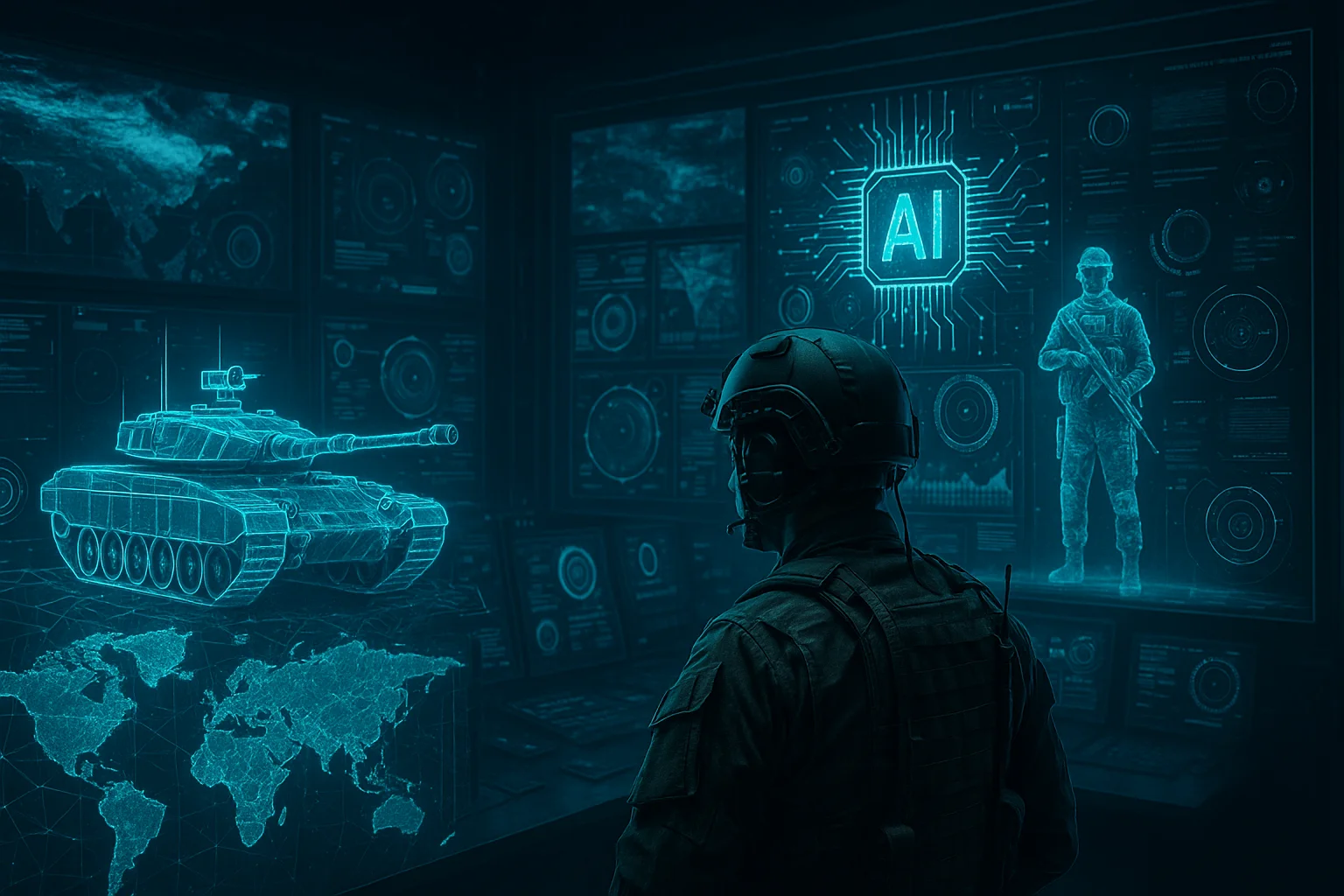
The India military AI initiative is redefining how the country approaches defense and national security. With rapid investments in artificial intelligence and autonomous systems, India is building a smarter, more agile military. The move strengthens surveillance, logistics, and decision-making across all branches of the armed forces while aligning with global shifts toward AI-driven warfare.
AI Integration Across the Armed Forces
India’s armed forces are actively deploying AI for surveillance, data fusion, and operational command. Institutions like the Defence AI Project Agency (DAIPA) and the Centre for Artificial Intelligence and Robotics (CAIR) lead the charge. These organizations coordinate AI research, implementation, and training within the Army, Navy, and Air Force.
The government has dedicated more than ₹100 crore (about $11 million) from its 2025–2026 defense budget to military AI development. This funding supports new programs in battlefield automation, intelligence analysis, and AI-based maintenance systems. The goal is to create a connected, data-driven defense network that enhances both speed and precision in operations.
AI on the Battlefield
Recent military operations highlight the effectiveness of India military AI tools. During Operation Sindoor in 2025, the armed forces deployed AI platforms such as the Electronic Intelligence Collation and Analysis System (ECAS) and Trinetra. These systems combined multiple intelligence feeds into one real-time picture, giving commanders better situational awareness and faster response capabilities.
The Indian Army has also adopted over 20 AI-based applications to support intelligence gathering, resource allocation, logistics, and predictive forecasting. These advancements reduce human error and help decision-makers analyze complex data within seconds.
Strategic Impact of AI Adoption
The growing use of India military AI represents a fundamental shift in defense strategy. AI now supports:
- Battlefield awareness: Integration of sensors and reconnaissance systems for real-time monitoring.
- Predictive maintenance: Automated diagnostics for vehicles and weapons to reduce downtime.
- Autonomous operations: Drone swarms and robotic systems enhancing mobility and reach.
- Data security: AI-powered tools to detect intrusions and protect classified networks.
While these technologies promise efficiency, they also raise ethical questions about autonomy, accountability, and human control in warfare.
Conclusion
The India military AI revolution demonstrates how artificial intelligence is reshaping defense strategies worldwide. For India, it marks the beginning of a new era—one defined by precision, automation, and rapid decision-making. As the nation continues to invest in AI-powered systems, its armed forces are evolving into a technologically advanced defense network capable of responding to threats with speed and intelligence.
0 responses to “AI Integration Across the Armed Forces”